What Calibration Actually Looks Like
Feb 09, 2026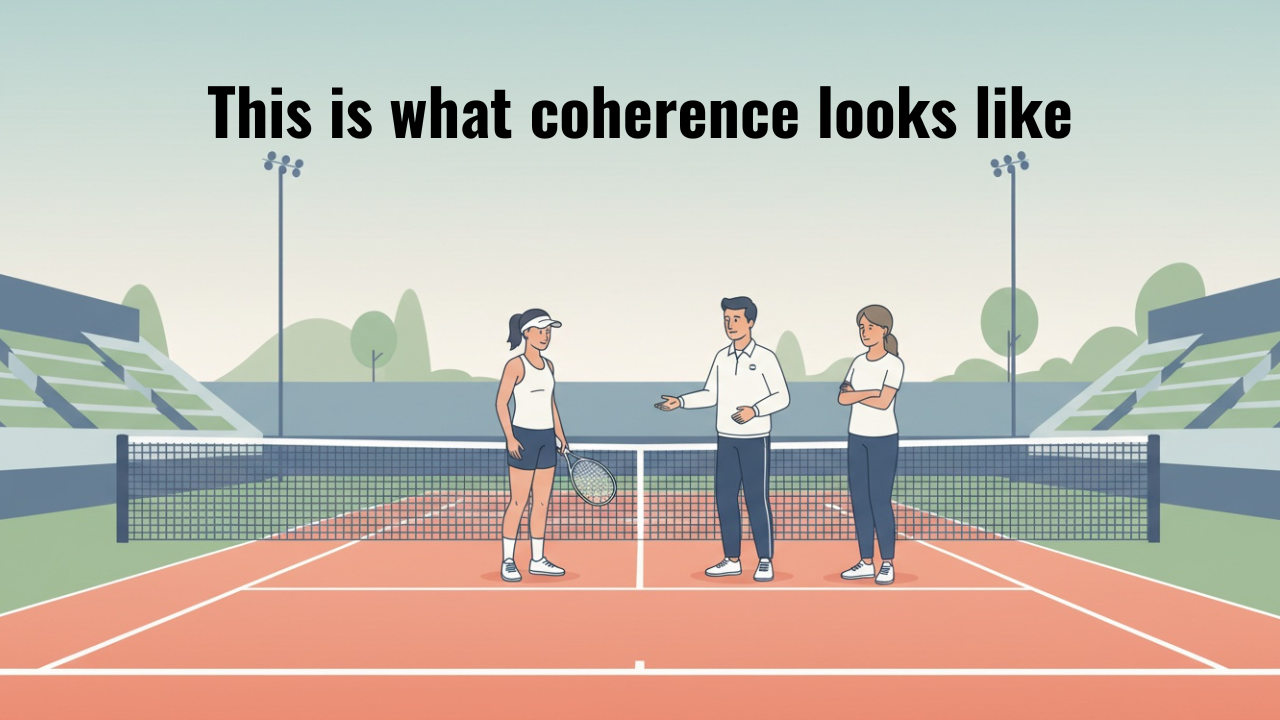
Most people can tell you when development feels wrong long before they can tell you when it feels right. They know confusion. They recognize frustration. They can describe what breakdown looks like in detail because breakdown announces itself loudly and demands attention. But calibration does not announce itself. It operates quietly. It shows up as coherence rather than excitement, as understanding rather than relief.
This is why calibration is so often invisible until it disappears.
After four essays examining where systems fail, what prevents them from seeing failure, how perspectives stay misaligned, and which signals reveal drift before damage accumulates, one question remains. What changes when calibration exists? Not as theory. Not as aspiration. As observable structure that functions differently than what most families have experienced.
Noise Reduction That Nobody Notices
The first marker of calibrated systems is what disappears. Conversations stop circling. Coaches stop repeating explanations that were supposed to be understood weeks ago. Parents stop translating between what the coach says and what the player hears. Players stop nodding while carrying confusion they cannot name.
This is not because everyone suddenly agrees. This is because everyone is finally looking at the same thing.
Feedback becomes shorter without becoming vague. A coach can say three sentences instead of fifteen because shared reference already exists. Questions become more precise. Instead of asking whether the player is confident, a parent can ask whether the tactical complexity in the last match exceeded the player's current processing speed. The player stops wondering if something is wrong with them and starts asking which specific variable needs adjustment.
Silence becomes productive rather than awkward. People can sit with information without needing to fill space with reassurance or justification. This is not disengagement. This is what alignment looks like when perception has converged enough that action no longer requires constant explanation.
When calibration exists, systems get quieter. Not because less communication happens, but because communication converges toward the actual constraints instead of scattering across mismatched interpretations.
Time Stops Behaving Strangely
In miscalibrated systems, time feels urgent and frozen simultaneously. Families feel pressure to act immediately while watching the same patterns repeat for months. Coaches feel rushed to produce results while waiting for learning that never consolidates. Players feel stuck inside constant evaluation where nothing they do seems to change what people see.
When calibration exists, urgency finds its proper place. People understand which changes should show up immediately and which require patience measured in quarters rather than weeks. Short-term results stop masquerading as long-term indicators. Long-term plans stop excusing present confusion.
A parent can watch their player lose a match badly and recognize that the loss revealed breakthrough in perception even though execution has not caught up yet. A coach can see hesitation under pressure and distinguish whether it signals indecision or whether the brain is managing more variables than it could six weeks ago. The player can explain what felt different without needing outcomes to validate the difference.
This does not eliminate impatience. It converts impatience from a reason to panic into information about where understanding needs to sharpen. Time stretches appropriately for learning. Time compresses appropriately for execution. Development starts operating in the right timeframes instead of collapsing everything into the urgency of the next match result.
Roles Clarify Without Becoming Rigid
Calibration does not blur roles through collaboration. It sharpens them through integration.
The coach focuses on instruction and pattern development without wondering whether interpretation will distort downstream. The parent focuses on decision-making and support without feeling responsible for diagnosing technical breakdowns they are not trained to see. The player focuses on execution and learning without carrying the emotional weight of everyone else's uncertainty about whether development is on track.
When calibration is absent, roles leak. Parents try to coach because they do not trust what the coach is seeing. Coaches try to manage parent anxiety because it interferes with training. Players try to protect adults from disappointment by performing confidence they do not feel. Everyone carries responsibility that does not belong to them while neglecting responsibility that does.
When calibration exists, each person stays inside their role without losing empathy for the others. This is not enforced through boundaries or communication protocols. It emerges because everyone trusts that what they are seeing is being seen by others through compatible frames. The coach does not need to convince the parent. The parent does not need to rescue the player. The player does not need to perform for the adults. Each person can do their actual job.
Disagreement Becomes Productive
Calibration does not eliminate disagreement. It changes how disagreement functions.
In miscalibrated systems, disagreement feels threatening because no one knows whose perspective is anchored to reality. A parent questions whether training volume is appropriate. The coach interprets this as mistrust. The player hears adults disagreeing and concludes the system does not know what it is doing. Agreement becomes a proxy for safety even when the agreement is built on misunderstanding.
When calibration exists, disagreement becomes information rather than threat. The coach can challenge a parent's interpretation of why the player withdrew after a loss without the parent feeling attacked. The parent can ask difficult questions about training priorities without the coach becoming defensive. The player can express confusion about feedback without everyone interpreting confusion as weakness or resistance.
This shift happens because cohesion is no longer built on agreement. Cohesion is built on shared reference. People can argue about meaning without arguing about legitimacy. They can question interpretation without questioning competence. They can disagree about priority without fragmenting trust.
When a system can disagree productively, learning accelerates because people stop protecting their positions and start examining their assumptions. That examination is what produces breakthrough. Polite consensus never does.
Learning Becomes Visible Before Results Change
One of the clearest markers of calibration is that learning becomes visible before outcomes improve. This reverses how most families experience development, where they are forced to wait for match results to tell them whether anything is working.
When calibration exists, the player can describe what they understood differently in the last match even when they lost. The coach can point to specific shifts in how the player organized information under pressure even when execution remained inconsistent. The parent can articulate why yesterday's meltdown revealed progress rather than regression because the meltdown happened at a higher level of complexity than previous ones.
This visibility changes everything. Patience becomes rational instead of forced. Setbacks stop feeling mysterious. Progress no longer depends on hope or faith. Everyone can see the architecture changing even when the scoreboard has not reflected that change yet.
Effort starts producing insight again. Not just fatigue. Not just frustration. Actual understanding that accumulates across time and translates into capability.
When families can see learning before results change, they stop making desperate moves in response to short-term outcomes. They stop changing coaches during slumps. They stop adding training volume to force breakthrough. They stop pressuring players to perform confidence they have not earned yet. The system stabilizes because everyone can see what is actually building underneath surface variability.
Emotional Load Redistributes
In miscalibrated systems, emotional load concentrates on the player. They carry anxiety about outcomes they do not fully understand. They absorb confusion created by misaligned adult perspectives. They carry responsibility for fixing problems that are actually systematic rather than personal.
When calibration exists, emotional load redistributes across the system in ways that protect the player's development without leaving adults helpless. Adults carry more interpretive responsibility. They do the work of integrating perspectives and translating between different timeframes and processing styles. Players carry more actionable clarity. They understand what they are supposed to be learning and why it matters and what the next step looks like.
Anxiety does not disappear. It becomes shared and contextualized rather than concentrated and internalized. The player still feels pressure before important matches, but the pressure connects to preparation rather than to vague fear about whether they are good enough. The parent still worries when results lag behind effort, but the worry connects to specific questions about whether training is targeting the right constraints rather than diffuse panic about wasted investment.
This redistribution is one of the quietest but most important shifts calibration produces. It is how identity damage gets prevented before it begins. It is how players develop without breaking. It is how families invest years without creating resentment.
Calibration Requires Structure Not Just Communication
The most common mistake families make after reading this far is believing calibration emerges through better communication habits or stronger relationships. Those things help. They do not create calibration on their own.
Calibration requires structure that holds perception long enough for accurate judgment to form. It requires memory across time so that patterns become visible instead of vanishing into the urgency of each new moment. It requires comparison across perspectives so that coach, parent, and player can integrate what they are seeing instead of operating inside separate reference frames. It requires translation between experiences that happen at different speeds and use different language systems.
Human attention cannot maintain this reliably without infrastructure support. Not because humans are incompetent, but because the cognitive load required to hold multiple perspectives in working memory while managing present demands exceeds what attention alone can sustain. Especially as systems grow. Especially as complexity increases.
When calibration exists consistently over years rather than appearing in flashes during particularly good stretches, it is because infrastructure is doing work that people cannot sustain through effort alone. Not replacing judgment. Supporting it. Not eliminating human perception. Amplifying it. Not removing expertise. Systematizing how expertise translates into development that compounds instead of eroding.
Why This Completes the Diagnostic Arc
The first essay in this series showed what happens when families solve the wrong problem because they cannot see what the actual problem is. The second essay showed why systems built without calibration infrastructure cannot see clearly at scale even when everyone involved is experienced and operating with good intentions. The third essay located the breakdown precisely in the gap between perspectives that never integrate. The fourth essay taught you how to recognize calibration failure through early signals that most families have learned to ignore.
This essay shows what becomes observable when those failures are addressed systematically rather than hopefully.
Not perfection. Not certainty. Coherence.
Calibration does not guarantee success. It guarantees that success and failure will both be intelligible. That distinction is everything. Intelligible failure produces learning. Mysterious failure produces drift. Intelligible success compounds into capability. Mysterious success disappears as quickly as it arrived.
When development is intelligible, families can invest with confidence even when outcomes are delayed. Coaches can protect long-term priorities without sounding defensive when parents want explanations. Players can persist through difficulty without accumulating damage. Effort produces understanding. Understanding produces direction. Direction produces depth.
That is what calibration enables. That is why everything in this series has been building toward this moment.
What Follows From Here
This completes the diagnostic arc of the Calibration Series. What comes next is not more explanation of problems. What comes next is design.
Design of systems that hold perception systematically instead of hoping perception aligns through goodwill. Design of processes that make learning visible before outcomes demand visibility. Design of environments where judgment forms accurately before decisions become irreversible.
That work requires more than awareness. It requires architecture. Architecture that most development systems do not have because they were never designed to solve calibration problems in the first place.
Next week we examine what that architecture looks like in practice. Not as philosophy about communication. Not as theory about development. As observable structure that makes the difference between systems that drift and systems that develop.
Calibration is not optional. It is foundational. When it exists, development becomes coherent. When it does not, families wander for years solving the wrong problems while wondering why effort is not translating into progress.
Everything that follows depends on understanding that difference.
This essay completes the diagnostic arc of the Calibration Series. What follows moves from diagnosis to design. New essays publish each Monday.
Never Miss a Moment
Join the mailing list to ensure you stay up to date on all things real.
I hate SPAM too. I'll never sell your information.
