What Happens When the Environment Starts Doing the Teaching
Apr 18, 2026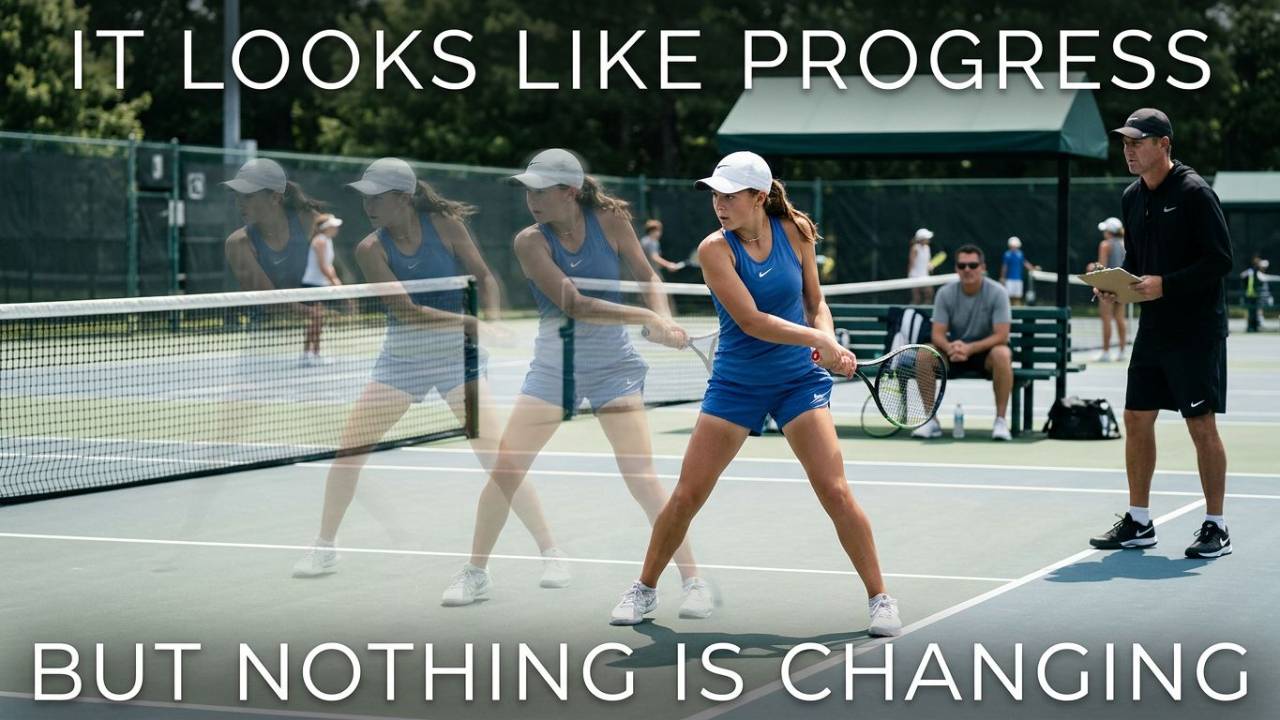
Saturday — April 18
---
The week looked like every other week. Practice on Monday. Match play Wednesday. Another session before the weekend. From where you were standing, the schedule was full and everyone was working. Your child was on the court, getting instruction, competing, receiving feedback. At the end of it, they were tired in the way a full week of junior tennis produces tired, and you had every reason to believe that somewhere inside all of that activity, something had been learned.
Then the next tournament arrives. The same problem shows up in the same situation, at the same point in the match, in the same conditions where it has always appeared.
Most families respond by adding something. Another session with a different coach for a second opinion. More match play. Extra video review. The reasoning is that more exposure will eventually close the gap between what the player knows and what they do when it matters. That reasoning is wrong, not because more work produces worse outcomes, but because the problem is not volume. The schedule is already full. What is missing is not another component. It is that none of the existing components have been asked to do a specific job, and without that assignment, the week is a sequence of events rather than a system. Practice produces balls hit. Matches produce results. Conversations produce evaluations. All of it sits beside the previous week without connecting to it, and the experience that should be compounding is resetting instead.
Most development environments are built this way not out of negligence but out of assumption. The assumption is that activity and development are essentially the same thing, that a player who is constantly in motion is constantly learning. It is the same assumption that produces the silence in the car after a match. The player has been on the court for two hours, something clearly happened, and yet there is nothing to access. Not because they were not paying attention, but because the environment never asked their attention to land anywhere specific. The experience passed through without leaving anything the player could examine later, because nothing in the structure was designed to hold it.
What changes when an environment is working is not the schedule. It is what each part of the schedule is being asked to produce. A training sequence that compresses the time between decisions is no longer just a drill. It has been assigned a job: make the player's decision-making visible before the session ends, while the player can still feel what they were choosing and why. The question that follows it, asking the player what they were trying to do rather than whether it worked, is not a coaching technique. It is the mechanism that keeps the experience intact long enough to be examined. Competition where behavior carries visible consequences beyond the individual point is not just match play. It is the environment revealing patterns that quieter settings conceal, because the cost of inattention is observable in ways the player cannot avoid.
None of this requires a different calendar. It requires that each existing part of the week be assigned a specific function and held to it. A drill that is not designed to make something visible is just activity. A conversation that begins with the adult's version of events rather than the player's is not a debrief. It is a verdict delivered after the evidence has already been reorganized around the result. The distinction is not subtle once you have seen it, but it is invisible when the frame you are using to evaluate the week is whether it looked productive rather than whether each part of it did a job.
Before the next practice, choose one ten-minute block and decide in advance what one question you will ask your player when it ends. Not whether it worked. Not what the score was. What were you trying to do on that point. That question, asked before you offer anything you saw from the outside, is the mechanism that keeps the experience close enough to examine. It takes thirty seconds. The conversation that follows it will be different in kind from the ones that have not been working, because it starts from inside the player's experience rather than from outside it.
For some families, this one adjustment changes the texture of how matches get processed and how the week connects to the one before it. For others, making the attempt reveals that the problem is not confined to a single session or conversation. It is structural, meaning it runs through how the entire environment is organized and what each component has been built to produce. When the problem is structural, the fix is not a different drill. It is a different design.
The Crossroads Audit was built for exactly that moment of recognition. It takes the match you just played, surfaces where the experience got lost before it could be examined, classifies the failure so you are not misreading a skill problem as a mental problem or a mental problem as a coaching problem, and forces one decision about direction before the next match arrives. If you have tried the adjustment and the same patterns keep appearing, the Audit is where to start. What it shows you may confirm that the problem runs deeper than one match can diagnose. That is useful information too.
Never Miss a Moment
Join the mailing list to ensure you stay up to date on all things real.
I hate SPAM too. I'll never sell your information.
