What Preserved Perception Actually Requires
Apr 09, 2026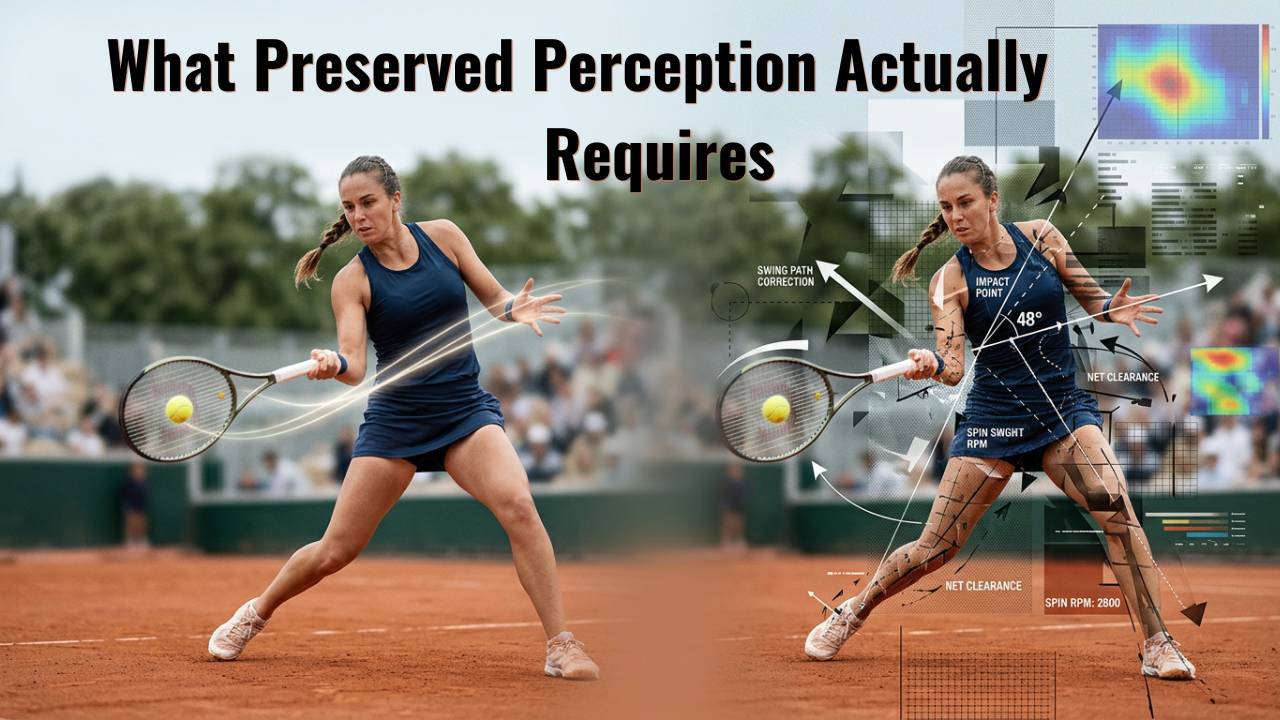
Thursday — April 9
There is a version of coaching that assumes the primary job is correction. It observes what happened, identifies what should have happened instead, and communicates the difference as precisely as possible. Sometimes this produces the desired outcome. More often it produces compliance without understanding. When it fails, the explanation is almost always the same: the player lacked focus, discipline, or the willingness to execute. The structure of the system itself is rarely examined.
The problem is not that correction is wrong. The problem is that correction assumes the player saw the same thing the coach saw. They did not. The player experienced the point from inside it. The coach observed it from outside. When the coach speaks first, what the player actually experienced gets reorganized around what the coach just described. It happens quickly, without anyone noticing, and it makes learning impossible in a particular way. Not because nothing is being communicated, but because what was actually experienced is gone before it can be examined.
Preserving perception means designing a process where the player's experience is not overwritten before it is understood. The first constraint is timing. The debrief has to happen close enough to the experience that the player can still access what they felt and what they saw. Wait too long and the memory reconstructs itself toward what makes sense in retrospect rather than what actually occurred. There is a window between the end of a point and the moment the player's mind shifts to narrative reconstruction, and that window has to be protected. The second constraint is sequence. The player has to go first. Not as preference, but as structure. The third constraint governs what happens inside that window. The questions that matter are the ones that send the player back into the experience as it happened rather than asking them to evaluate it from the outside — what were you trying to do, what did you see, what did you expect to happen. These questions open the space without organizing it. The player's account fills it in.
Integration is where the other perspectives enter, and the sequence is non-negotiable. The coach's observation belongs in the conversation. Data belongs in the conversation. But these perspectives are introduced after the player's experience is on the table, not before. When the coach's interpretation precedes the player's account, what follows is the player locating themselves inside the coach's version of events. When the player's account precedes everything else, comparison becomes possible. The gap between what the player intended, what they saw, and what the coach observed is where the most accurate diagnosis lives.
When these constraints are present, the player begins to recognize patterns in their own behavior across time rather than receiving a new evaluation after each performance. Self-correction follows from this capacity because the player can see what is happening without being told. When the constraints are absent, a different skill develops instead, one the system mistakenly rewards: the player learns to describe what the coach wants to hear, to receive feedback in the form the system requires, and to move on from a point without the experience of it having been understood. The appearance of learning is well maintained. What the system does not produce is a player who can see themselves accurately under pressure, because the structure never required them to.
This is what building the container actually demands. Not a set of ideas about learning, but a set of constraints that protect how experience gets processed before any interpretation reaches it. Tuesday described what building looks like from the outside. This is what it looks like in the architecture itself. Saturday shows what it looks like from inside a family that has been operating without it.
Never Miss a Moment
Join the mailing list to ensure you stay up to date on all things real.
I hate SPAM too. I'll never sell your information.
