What Preserving Signal Actually Looks Like
May 28, 2026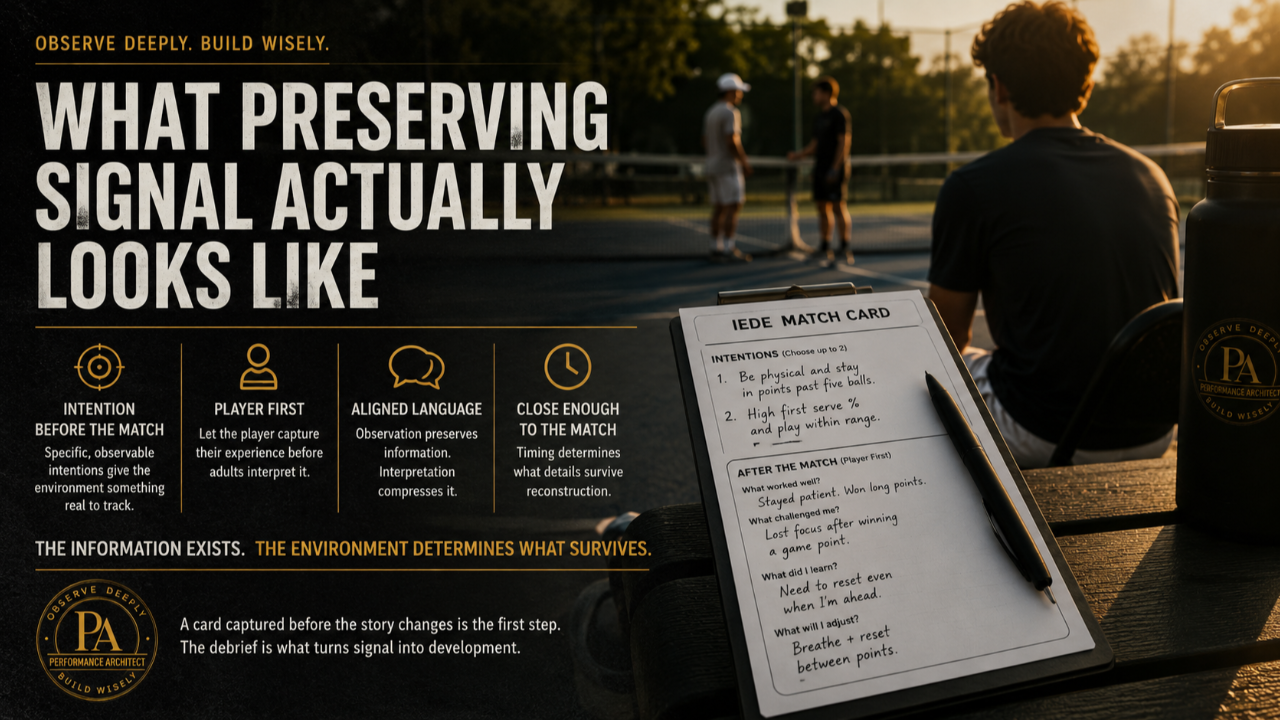
Thursday — May 28
The environments that hold developmental information don't announce themselves as different. They contain the same components: courts, coaches, competition schedules, parent observers, and the conversations that follow matches. What separates them from environments that destroy information faster than they build it is not a visible feature but a behavioral one, and it becomes apparent almost immediately to anyone who knows what to look for.
The first place it shows up is before the match begins.
In most programs, the player walks onto the court carrying a general orientation: compete hard, stay mentally engaged, make good decisions under pressure. These are orientations, not intentions, and the distinction does more work than it sounds like it should. An orientation gives the player nothing observable to return to after the match ends. An intention tied to a specific behavior under defined conditions gives the player, the coach, and the parent something the environment can actually examine.
A coach recently ran a college dual match format inside an academy practice, real competitive stakes, real scorekeeping, and had each player complete an IEDE match card before play began. The card structure requires no more than two intentions, and that constraint turned out to be the mechanism, not an administrative choice. More than two and the player can't track in real time. The intention becomes aspiration, something they meant to do rather than something they can monitor during the point. One player committed to being physical and staying in points past five balls. Another committed to a high first serve percentage and playing within range. Another to aggressive forehand patterns inside-out. Every player walked onto the court with something specific enough to return to, observable enough to evaluate without a coach present. That is what an intention actually is: a constraint the player can apply to their own behavior during the moment, not a goal for the outcome of the match.
Without it, the conversation after the match evaluates performance against an internal standard nobody else can access, which is the condition that produces three disconnected accounts of the same ninety minutes.
The second behavioral difference is where most environments fail without recognizing it as failure. The player has to speak first, and the adult has to hold back long enough for that to happen. That restraint isn't passive. Coaches and parents intervene early because they believe speed is useful, that the correction delivered closer to the error has more impact than one delivered later, that their external view of what happened is more reliable than the player's internal one. Speed and usefulness are not the same thing. A player who initially registered something specific collapsing when the match got close will abandon that observation and absorb whatever framework the adult offers, even when the adult's framework is inaccurate, because the mind under social pressure resolves toward coherence faster than it resolves toward accuracy.
The match cards from that practice session are worth examining on this point. One player identified that his breakdown happened not when he was losing, but after winning a game point. That's a specific, recoverable observation about a pattern that operates inside success rather than failure, and it wouldn't survive a coach-first debrief. A coach watching from the outside would have seen a coherent arc, the player competed well, held his intention, won those long points, and organized the match around that account. The player, working from inside it and prompted by the card before anyone spoke to him, located the specific moment where something slipped. Another player traced a breakdown sequence in his own words: missed first serve, then nerves, then physical collapse, then errors. Three events in sequence. A standard post-match conversation would have collapsed that chain into a single conclusion, he got tight, and the developmental picture would have been narrower by exactly the distance between that conclusion and what actually happened in that order. Both of those accounts exist because the card required the player to look before anyone else organized the match for them.
The third element fails quietly, which is what makes it difficult to address. Parents and coaches operating from different conceptual frameworks don't produce visible conflict. They produce invisible misalignment, and the player absorbs both signals simultaneously without the ability to reconcile them. The parent is supporting confidence and the coach is building accountability, and the player experiences both as pressure and neither as information. The language hasn't been calibrated to the same function. Telling a player that they stopped trusting their forehand in the second set when the score tightened is an observation. Telling a player they got nervous again is an interpretation. Those aren't interchangeable statements. One gives the player something they can examine and potentially correct. The other gives them a conclusion that's difficult to argue against and equally difficult to act on. Two well-intentioned adults running incompatible frameworks produce a player who learns to manage the environment rather than learn from it.
The fourth element is timing, and it degrades faster than most programs account for. The player who left the court sensing something specific, that his breakdown came immediately after winning a game point, arrives at the next session with something simpler: I always tighten up in big moments. The detail disappeared first. The generalization survived. That generalization may contain partial truth. It doesn't contain the specific, recoverable information that would allow anyone to design a developmental response to it, and no amount of instructional quality in the subsequent session can reconstruct what the window after the match failed to hold.
The practice itself wasn't built as a formal IEDE implementation. A coach introduced the cards into an otherwise normal competitive session and watched what surfaced once the players had a structure for capturing their own experience. Which makes what came next more revealing rather than less: the cards were where the loop stopped. The signal survived on paper, close enough to the match for the details to remain intact. What happened after that is the important question. Was the pattern one player noticed about winning game points ever examined? Did the other player's collapse sequence ever become a training adjustment? A card that is captured and not examined is better than no capture at all. But capture and debrief are different acts, and the developmental loop does not close at capture.
Tuesday named where the failure actually lives: not in the content delivered on court, but in the twenty-three hours between what the player experienced and when someone capable of acting on it receives a usable version. What this piece is describing isn't a framework for fixing that failure. It's what the fix looks like as behavior, in observable habits, in a sequence that either holds signal intact or allows it to harden into a story nobody can learn from. Intention before the match, narrow enough to track in real time. Player account before adult interpretation. Compatible language between the adults in the system. Debrief close enough to the experience that the details are still accessible. None of those requirements are complicated. All of them require a structure that most environments haven't been asked to build, because most environments have been measuring the output of development rather than the integrity of the process that produces it.
The cards from that practice session show what the first part of that structure looks like when it runs. What happened after the cards is the part that still needs to be built.
*If the loop in your environment is breaking down and you can feel it but cannot locate exactly where, the Crossroads Audit was built for that diagnosis. [[email protected]](mailto:[email protected]) / 469.955.DUEY (3839)*
*The Match Intelligence Lab is where coaches and serious families work through implementation together: [skool.com/match-intelligence-lab-6336/about](https://www.skool.com/match-intelligence-lab-6336/about)*
Never Miss a Moment
Join the mailing list to ensure you stay up to date on all things real.
I hate SPAM too. I'll never sell your information.
