What Six Weeks Inside the Loop Actually Produces
Apr 25, 2026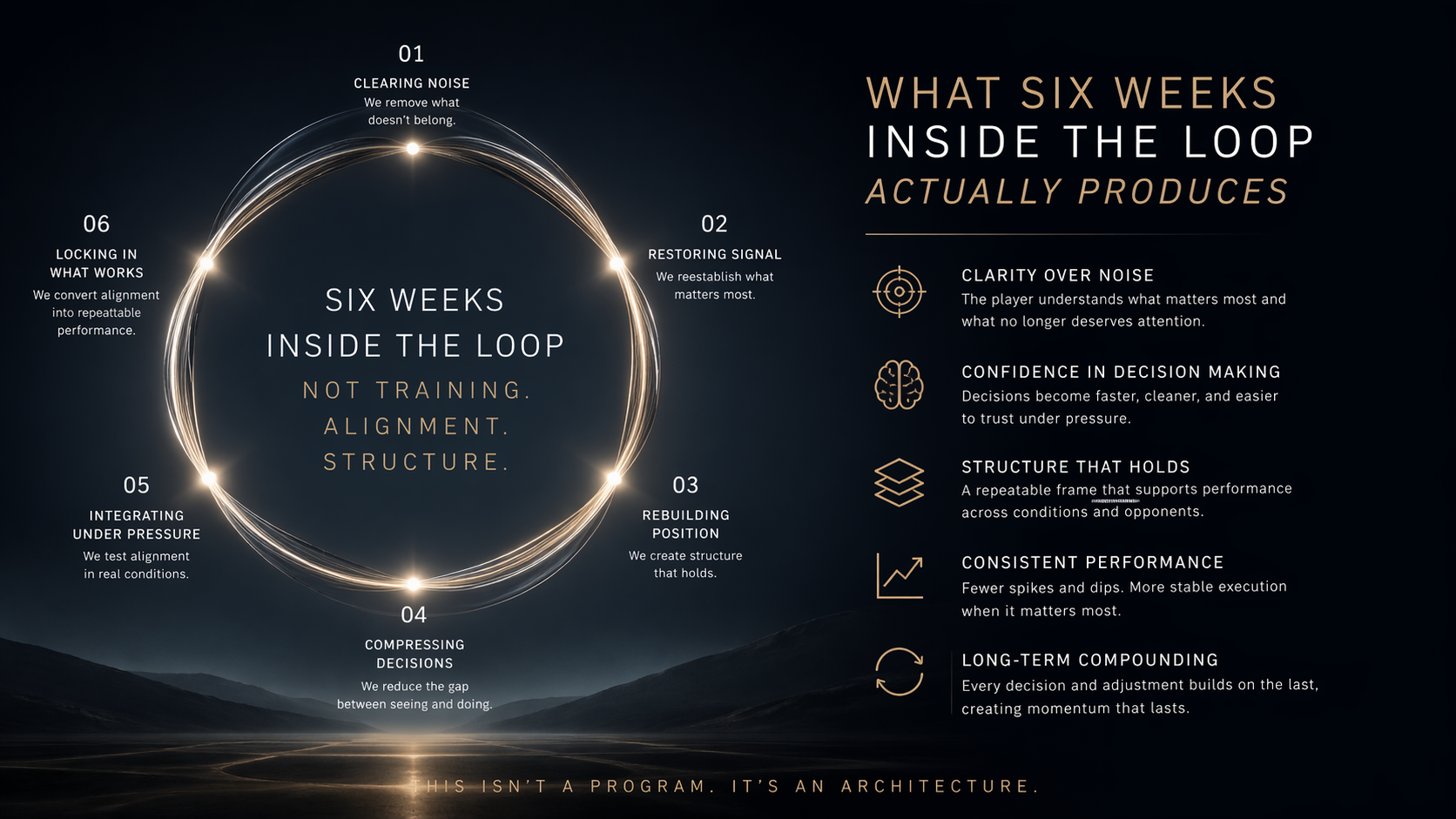
Saturday — April 25
At some point most families arrive at the same conclusion. The player is not locked in. They are not bringing the right focus. They compete well in practice and something changes when the match is real. When that gap shows up often enough, character starts to seem like the most logical explanation. The parent is not wrong about what they observed. They are wrong about what it means. The pattern they are reading as a motivation problem or a mental problem is almost always a structural one, and the difference between those two diagnoses determines everything that happens next.
When the conclusion is that the player needs to care more or focus harder, the response follows directly from it. More pressure around performance. Conversations about what it takes. A coaching change, because maybe a different voice will reach what the current one has not. Some of these adjustments shift things temporarily. None of them move the underlying pattern, because the underlying pattern is not located in the player. It is located in what the environment is or is not asking the player to do with their experience between matches.
The loop that learning requires does not exist by default in most junior development environments. What exists is a sequence of events: practice, match, conversation, next practice. Each of those events produces something, but none of what they produce connects to what came before it. The match generates an experience that degrades almost immediately and gets replaced by a narrative organized around the result. The conversation after the match works with that narrative rather than the experience itself, which means the adult is interpreting a reconstruction while the player is locating themselves inside someone else's version of what happened. The next practice has no relationship to either the match or the conversation because nothing was captured in a form that could travel.
Each week sits beside the previous one without connecting to it, and the player's development resets instead of compounding. When a player is asked what they were thinking on a given point and says "I don't know," the answer is almost always read as a sign of disengagement. It is not. It is the absence of a trained pathway. When nothing in the structure has ever asked the player's attention to land anywhere specific, the mind fills the space after a point with whatever is most available — frustration, habit language, outcome — because nothing has ever required it to do anything else. That is not a focus problem. It is a design problem.
Once nothing is being captured, nothing can carry forward. When that changes, what the environment produces changes with it. A player who is asked to declare one thing they are paying attention to before a match walks onto the court differently than a player who is simply told to compete. The declared intention creates an anchor that makes the experience navigable rather than continuous. After the match, when the conversation returns to that single declared point rather than to the result, the player can access what actually happened inside the experience because there is somewhere specific to look. The debrief is no longer a verdict delivered from the outside. It is an examination of something the player named in advance and can now return to. That sequence, repeated across six weeks, produces a player who is learning to examine their own performance accurately, which is the only capacity that will be available to them when the match gets tight and no one from the outside can reach them.
Before the next match, try this: ask your player one question before they walk on the court. Not about the opponent, not about strategy. What are you paying attention to today? Write the answer down, or have them write it. Keep it to one thing. After the match, before any other conversation, come back to that single point. Not the score. Not what you saw from the stands. Just that. Did they stay with it? What happened when they did, and what happened when they lost it. The question, asked from within the player's own declared frame rather than from your observation position, opens a conversation that is different in kind from the ones that have not been working. It will not solve everything. It will show you what becomes possible when the experience has somewhere specific to go.
For some families, that one change is enough to shift how matches get processed and how the week connects to the one before it. For others, making the attempt reveals how much of the structure around the player is not built to hold what the loop requires. The single question surfaces useful information either way, because a player who cannot answer it, or who has already moved too far from the experience to access what actually happened, is showing you exactly where the breakdown is.
What six weeks inside a fully installed loop produces is not a finished player and it is not a solved problem. It is a family that has stopped starting over after every match. The player begins to examine performance rather than react to outcome. The coach gains access to what the player actually experienced rather than the version that survived the wait. The conversations get shorter and more useful because the structure is doing work that the conversation has been trying to do alone. That is what the first cohort is built to install, over six weeks beginning May 24, with guidance on when to speak, when not to, and how to let the player's understanding actually form. If you are not ready for that step yet, the Crossroads Audit is where to start. It shows you exactly where the experience is disappearing, and what that gap is actually costing.
Never Miss a Moment
Join the mailing list to ensure you stay up to date on all things real.
I hate SPAM too. I'll never sell your information.
