When Should a Player Stop Needing the Coach?
Sep 17, 2026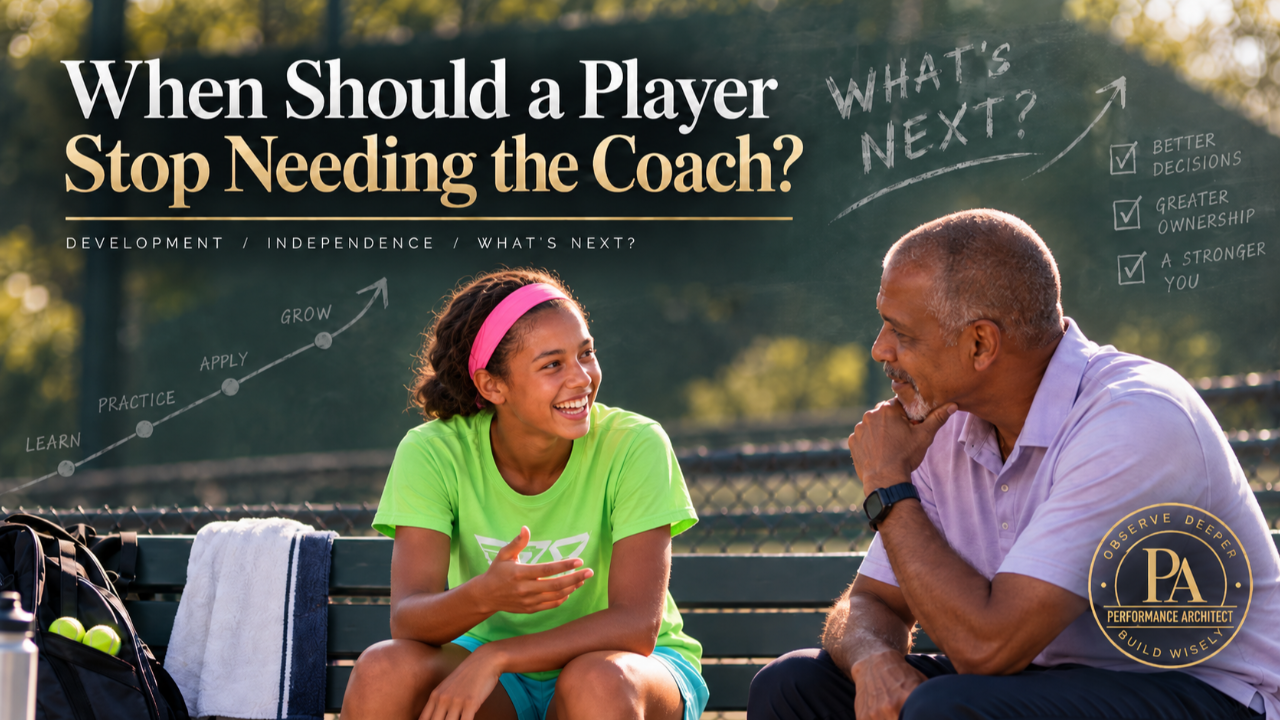
One of the questions that came up in our classroom work was whether a fourteen-year-old should need the same amount of external accountability as an eighteen-year-old.
The easy answer is no. The harder question is what should actually be different.
An eighteen-year-old may still have a coach. A twenty-five-year-old professional may have several. The best players in the world aren't proof that development eventually makes coaching unnecessary. If anything, they may have more expertise around them than they had when they were younger.
So the goal can't be to stop needing a coach. Maybe the goal is to stop needing the coach for the same things.
That distinction feels important after the first five essays in this series. We started with transfer, asking whether something we taught could survive outside the environment where we taught it. Then awareness, judgment and testing, as the player began taking over some of the noticing and questioning the coach had previously done. Integrity asked whether the standard could survive when nobody was enforcing it.
Every one of those questions has really been about the same thing. Who is doing the work? Not the physical work. The other work. Who notices, who remembers, who interprets, who decides what matters, who recognizes when something has changed, who asks the next question, who carries the standard?
When a player is young, the honest answer may be that the adults do a lot of it. That isn't necessarily a problem.
A young player may need a coach to say, "Your attention is gone," or somebody to remind him what he was supposed to be working on. He may need a parent to get him to the tournament, make sure the rackets are in the car and know when the next match is scheduled, or a coach to tell him which part of the last match deserves attention and which part should simply be left alone. That's part of what adults are there for.
But if we are still doing exactly the same work for the player years later, something probably hasn't moved. The question I keep coming back to is not whether the player still needs us. It's what he needs us for now.
A younger player might finish a match and say, "I lost." The coach starts asking questions. What happened? What was working? When did it change? What did the opponent keep doing? What happened on the important points?
Eventually, I'd hope the player starts arriving with some of that information already. "I kept getting short balls when I played through the middle, but I didn't finish them very well." Now we're having a different conversation.
The player has already noticed something. He's interpreted at least part of it. Maybe he tested it. He has started identifying where the problem actually lives. The coach still matters, maybe more than ever, but the coach is no longer required to manufacture the entire conversation. That seems like development to me.
We've talked a lot in these classroom sessions about awareness, accountability and integrity, but one of the things I'm beginning to see is that the amount of coaching can't be the only measure of whether we're helping. The location of the coaching matters too.
Is it all coming from outside the player? Or is the player beginning to bring something back?
That may be why I'm uncomfortable with the phrase "independent player." Tennis is too complicated for that. Good players use coaches. Good coaches use other coaches. Professionals have teams. A player may need a technical specialist, a strength coach, somebody watching matches, somebody helping with scheduling, somebody who knows him well enough to recognize something he can't see himself.
Needing another set of eyes isn't developmental failure. Sometimes another set of eyes is exactly what development requires. The difference is what the player does with them.
A player can use a coach as a source of answers, or he can use a coach as a resource for examining questions he has already started asking. Those aren't the same relationship.
I think back to the classroom discussion about accountability. One of the older players argued that coaches, parents and teachers can still be resources while a player is learning to take more responsibility for himself. That made sense to me. Development doesn't require removing the adults. It requires changing what the adults are carrying.
Maybe at ten, the coach notices first. At thirteen, the coach notices and asks whether the player noticed too. At fifteen, the player notices and brings it to the coach. At seventeen, the player may notice, form an explanation, test it and then ask the coach whether he's missing anything.
Those ages aren't rules. Players don't develop in straight lines, and they certainly don't develop every part of themselves at the same pace. But the direction matters.
The player is doing more before the coach has to enter the conversation. That may be a better definition of the handoff than independence. The player isn't being separated from support. He is arriving at the support differently.
There is a version of coaching that can make us feel very useful. The player comes off the court and we tell him everything we saw. His return position was too close. He stopped using his between-point routine. He was rushing his forehand. He didn't recognize that the opponent was getting uncomfortable when the ball got high. He abandoned the pattern that had been working.
That's useful information. Sometimes the player absolutely needs it. But there is another question we can ask before giving him any of it.
What did you see?
That question can be uncomfortable for the coach because the player may miss the thing we think is obvious. He may talk about something completely different. He may say he doesn't know. There are days when letting him struggle toward an answer takes longer than simply telling him. But if I answer every question before the player has a chance to ask it, I shouldn't be surprised when he keeps waiting for me.
That has probably been one of the recurring lessons of this entire series. We can become so efficient at coaching that the player gets very little practice doing some of the things we eventually expect him to do alone. We recognize the drift, diagnose the pattern, set the intention, tell him what the match meant, and decide what the next training block should address. Then tournament Saturday arrives, the gate closes, and we want him to do all of that himself.
The handoff can't begin at the gate. It has to be happening long before then. That doesn't mean standing back while a player flounders. It means paying attention to what he can reasonably carry now that he couldn't carry six months ago.
Maybe I don't need to give him the training priority anymore. Maybe he has already identified something in the match that gives the next block a reason. That's not less coaching. It may be more demanding coaching. Telling is often faster. Knowing when not to tell is harder.
There is another side to this that matters. As the player takes more responsibility, the coach should become more valuable, not less. If the player can already notice that his return position is wrong, he doesn't need me simply to announce that his return position is wrong.
He may need me to help him understand why he keeps returning there, offer another perspective on what he thinks he saw, challenge a conclusion he reached too quickly, or recognize a pattern he has only experienced once because I've seen it in fifty players. The quality of the conversation can rise as the player becomes more capable of participating in it.
That feels very different from the idea that maturity means the player should no longer need help. Maybe maturity means he becomes better at knowing what kind of help he needs. That includes knowing when he doesn't know.
I think that's one of the more sophisticated forms of ownership. Not pretending you have every answer. Knowing enough about your own game to recognize where another perspective might help.
That is why I don't think the developmental handoff ends with the coach disappearing.
Early on, the coach may carry the question. Later, the coach helps sharpen the player's question. Early on, the coach supplies the observation. Later, the coach compares observations with the player. Early on, the coach defines the standard. Later, the coach helps the player examine whether the standard still makes sense. Early on, the coach may provide the answer. Later, maybe the coach's most useful contribution is another question.
We've already seen some of that in the classroom. When the players were discussing awareness and accountability, the best moments weren't necessarily when one of us gave them the right answer. They were often when one player said something and another player changed the problem.
Is accountability holding yourself to your own standard or the group's? What if your personal standard is only to have fun? What if accountability means being somebody your teammate can rely on?
Now the adults don't own the whole conversation. That's important. The same thing should probably happen in the player-coach relationship over time. A developmental relationship should become less one-directional. Sometimes the player changes his mind. Sometimes the coach should too. If we're serious about developing thinking players, that has to be possible.
There is probably no age when a player should stop needing the coach. But there should probably come a point when the coach can feel the relationship changing.
The player walks over before being called. He asks a question before receiving the answer. He says what he noticed before being told what happened. He identifies the problem before asking how to fix it. He tells the truth about the match even when the truth isn't particularly flattering. He asks for help because he has reached the edge of what he can currently see, not simply because he has been trained to wait for instructions.
That sounds like a player who still needs a coach. Just not for everything he used to.
Maybe that's the last piece of the developmental handoff. Not independence from coaching. A different relationship with it.
The coach is still there. But more and more of the player has arrived too.
Never Miss a Moment
Join the mailing list to ensure you stay up to date on all things real.
I hate SPAM too. I'll never sell your information.
