When Someone Else Goes First
Jan 18, 2026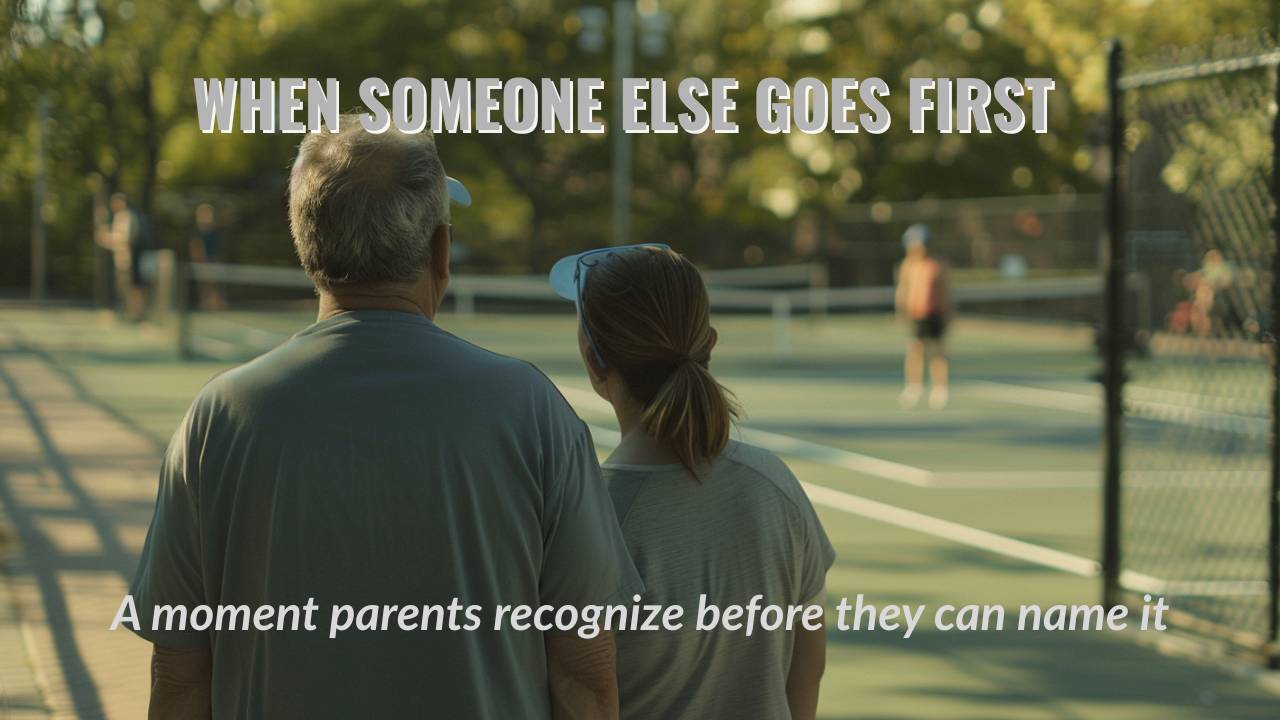
Most families do not arrive at serious commitment through ambition. They arrive through proximity. They watch another family take a step they were not ready to take themselves. They notice a change. The questions become sharper. The conversations shift tone. The stakes feel different. Nothing dramatic happens on the surface, but something internal moves.
You know the moment. You are standing courtside during a practice session that looks identical to dozens before it. But this time, when your child misses, they do not shake it off. They stop. They think. They ask a question about why rather than what. Something has shifted from doing to understanding. And you realize you are no longer watching casual participation. You are watching someone choose depth over breadth. The decision was not announced. It simply became visible.
This is the moment when parents realize their child is no longer exploring broadly. The interest has narrowed. Not in a constricting way, but in a deliberate one. The child is not trying more things. They are trying to understand one thing more deeply. That shift is subtle, and it is easy to miss if you are not paying close attention. It rarely announces itself with performance outcomes. It shows up in persistence. In how the child talks about practice. In the way disappointment lingers rather than evaporates. In the questions they ask after losing.
For most parents, this realization does not arrive in isolation. It arrives because they know someone who has already crossed that threshold. A family they trained alongside. A child who competed in the same draws. A parent they shared tournament weekends with. Suddenly that other family is making different choices. Training looks different. Calendars look different. Conversations sound different. Not necessarily better. Just different. And in that difference, parents begin to see a path they had not quite been able to imagine on their own.
This is often the first time parents feel the weight of choice. Until then, participation carried the illusion of reversibility. You could adjust schedules, switch coaches, try something else next season. But once depth replaces breadth, decisions begin to stack. They start to interact with each other. Time matters more. Alignment matters more. Mistakes feel heavier because they feel harder to undo. What was once flexible becomes consequential.
What surprises most parents is not that this moment arrives. It is that no one explains it when it does. There is no shared language for the transition from trying to building. No widely accepted way to talk about intention without immediately triggering fear or escalation. As a result, parents do what humans have always done in moments of uncertainty. They look sideways. They ask quiet questions of people they trust. Not experts. Not authorities. Other parents who seem close enough to understand and far enough along to offer perspective.
These conversations are rarely formal. They happen in passing. In parking lots. Over coffee. Through messages that start with hesitation and end with relief. What parents are seeking in these moments is not instruction. It is orientation. Orientation is different from advice. Advice tells you what to do. Orientation helps you understand where you are. When families enter the uncertain middle, they face a specific challenge. They do not want guarantees. They want to know whether what they are seeing is normal. Whether the confusion they feel is expected. Whether the discomfort is a signal to stop or a sign that something important is beginning. This is the territory between casual participation and committed development. Old assumptions no longer fit, but new patterns have not yet become clear.
This is why peer knowledge becomes so powerful at this stage. A parent who has already made the jump can say something simple. We thought that too. That part was harder than we expected. We wish we had slowed down right there. These statements do not prescribe action. They create context. They help parents distinguish between discomfort that accompanies growth and misalignment that requires correction. That distinction is nearly impossible to see from inside your own situation. It becomes visible only when someone else describes their experience honestly enough that you recognize the pattern.
What often goes unspoken is that courage is unevenly distributed over time. Some families move earlier because they have access to better information. Others move because circumstances force their hand. Many wait because they do not yet trust their own judgment. When a nearby family steps forward and survives the uncertainty, it lowers the psychological cost for others. Someone else going first makes it possible to imagine doing the same without feeling reckless. This is not imitation. It is permission.
The system rarely recognizes this dynamic. Development models assume rational decision making driven by objective criteria. In reality, parents are responding to narrative coherence. They are watching how decisions play out in real lives, not on paper. A pathway becomes believable when it is embodied by someone they know, not when it is explained by someone they do not. Proximity creates credibility in ways that credentials cannot.
This is why so many families arrive seeking clarity only after the moment has passed. They did not lack motivation earlier. They lacked confidence that they were interpreting the signals correctly. By the time they reach out, the cost of delay has already been felt. Not always in lost opportunity, but in unnecessary stress, wasted resources, or reactive decisions made under pressure. The window for thoughtful deliberation closes faster than most parents expect.
The tragedy is not that families hesitate. Hesitation is appropriate in complex systems. The tragedy is that there are so few structures designed to help families think together at the moment when thinking matters most. Instead, parents are left to triangulate truth through fragmented stories, partial successes, and selective visibility. Those with better access move sooner. Those without wait longer. The gap widens, not because of talent, but because of timing.
What parents need in this moment is not acceleration. It is calibration. They need help understanding what depth actually demands and what it does not. They need to see that serious pursuit does not require immediate foreclosure of other identities. They need reassurance that patience is not the same as complacency. They need examples of families who took the long view and did not regret it. Most importantly, they need places where these conversations can happen without performance. Where admitting uncertainty does not feel like exposing weakness. Where the quiet knowledge parents already carry can be surfaced, compared, and refined without hierarchy.
When those spaces exist, families do not need to be pushed. They move when they are ready, with fewer regrets and clearer intent. The moment when a child chooses depth over breadth is not a call to action. It is a call to understanding. Families who navigate it well rarely do so alone. They do so because someone else went first, spoke honestly, and made the path visible without insisting it be followed.
Systems that ignore this proximity principle pay a predictable cost. They lose families who would have stayed if they had felt less alone. They lose the collective wisdom that accumulates when people compare experiences openly. They lose the calibration that happens when multiple families test similar decisions and report back honestly. Most critically, they lose the ability to distinguish between families who need to slow down and families who need permission to move forward. Without peer knowledge circulating freely, every decision feels equally risky, which means families either freeze or accelerate without sufficient context for either choice.
Real learning does not flow from authority to recipient. It moves sideways. Through proximity. Through recognition. Through the courage of one family quietly making it easier for another to see what might be possible. When someone else goes first and survives the uncertainty, they create more than a pathway. They create permission for others to trust what they already see in their own children.
Never Miss a Moment
Join the mailing list to ensure you stay up to date on all things real.
I hate SPAM too. I'll never sell your information.
