When the Design Question Reopens
Feb 26, 2026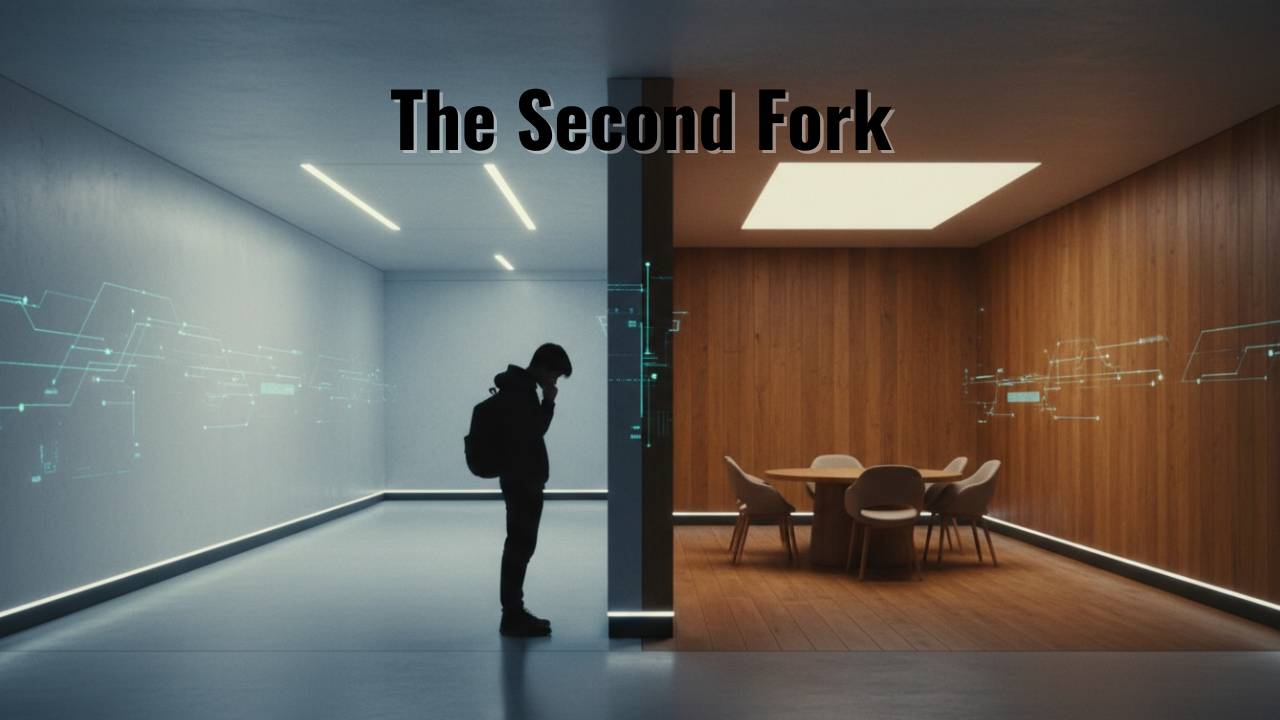
By Duey Evans
I listen to Moonshots fairly regularly. It is one of those shows that lives in the same neighborhood as the world I have been building toward, even when the host's enthusiasm outruns the evidence. Peter Diamandis has a gift for framing technological change as something that lifts all boats simultaneously. I am more cautious than that. My mind tends to follow Dave Blundin and Salim Ismail into the second question, the third question, the place where consequence lives after the applause dies down. Which is why today's episode caught me sideways. Not because it confirmed what I already believed, though it did some of that. Because it was local. Alpha School, the AI-native K-12 model being discussed, is in Austin. I live in Austin. I follow education conversations. I have been inside a thirty-year study of what goes wrong when development is mishandled, and I had never heard of them. That is its own kind of information.
The model, as described in the episode, is built around a claim that makes traditional educators nervous and makes high-agency parents lean forward. Two hours of academic work each morning, mastery-based rather than time-based, driven by AI personalization that adjusts pacing and content to the individual child. After that, the rest of the day opens into workshops, projects, life skills, and applied work. The adults in the room are called guides, and their job is explicitly not to deliver academic instruction. Their job is to coach motivation, to catch self-defeating learning habits, to help kids stay in the process when it gets hard. The whole system runs closed-loop feedback: learn, measure, adjust, repeat. XP points. Waste meters. Iterations every eight weeks. The model does not apologize for being engineered. It is proud of being engineered, and that pride is not entirely misplaced.
Here is the convergence that stopped me. The guide model, as Mackenzie Price described it, is structurally similar to something I arrived at independently after thirty-five years on tennis courts. I have never believed that instructing mechanics is the primary job. Mechanics matter, but mechanics are not the lever. The lever is awareness, intention, and perception. The coach who only polishes technique is building on sand. The coach who develops a player's ability to see clearly, decide under pressure, and adapt in real time is building on bedrock. That is why I describe, probe, and plan rather than instruct. When a guide stops delivering content and starts coaching the act of learning, they are making the same structural move on a much larger stage. Two fields, two timelines, one correction. That is not coincidence. That is the old architecture failing loudly enough that people in separate rooms are hearing it at the same time.
The mastery-based framing belongs in the same category. The episode's argument (that time-based systems are effectively IQ-coded and conscientiousness-coded, that they only work cleanly for a narrow slice of children and quietly damage everyone else) is the Alcott Dilemma stated in business school language. I have been living inside that dilemma for a long time, from a different angle, watching it operate in junior tennis development rather than K-12 schooling. The child who gets labeled early and permanently as "not a player" often has nothing wrong with her except that the system had no patience for her particular developmental clock. The system sorts children into identities they did not choose and cannot easily escape. Alpha is at least trying to break that sorting mechanism. That matters.
What Alpha is not doing is equally important to name, not as criticism, but as precision. Alpha is solving a logistics problem with considerable elegance. The logistics problem is this: academic content delivery through a teacher in front of a classroom is slow, poorly calibrated, and unavoidably averaged. AI can personalize it, accelerate it, and compress it. That is real. The compression is real. The improvement in academic throughput is likely real. But the compression does not answer the question it raises. If you can genuinely deliver academic mastery in two focused hours, then what is school actually for? That is not a rhetorical question. It is the question that reopens the design space entirely, and it is not answered by better workshops or higher SAT averages.
There is a population for whom that reopened afternoon is not an abstract opportunity. Serious junior athletes have always had a schooling problem. The traditional model was never designed to accommodate a child whose development requires a different relationship with time. Online school has been the standard workaround, and it is a mediocre one. The child complies with it rather than engages with it. It gets the box checked. What Alpha is describing is categorically different: two hours of mastery-based progression with real feedback loops, and then a genuinely open afternoon. For a junior athlete inside a development program that treats formation seriously, that open afternoon is not empty. It is where the other architecture lives. Academic compression in the morning and a principled development environment in the afternoon are not competing models. They stack. One solves the logistics of academic throughput. The other addresses the formation question that throughput cannot touch. Together they describe a coherent day that has never been available to a junior athlete before, at least not by design. That is the theoretical possibility worth sitting with. Not two institutions negotiating territory, but two layers of a single architecture, each doing what the other cannot. The risk worth naming is that freed time is not neutral. It can be used for formation or it can be wasted faster than the old machine ever allowed, and a compressed morning with an unstructured afternoon is not a coherent day. It is just a different kind of emptiness.
This is the second fork in the road. The first fork was time-based efficiency versus relational formation. The second fork is AI-accelerated mastery versus human formation governance. The first fork happened in the nineteenth century, and most people are unaware it happened at all, because the path not taken was buried under so many decades of normalcy. Horace Mann imported a Prussian model built for efficiency, standardization, and the production of literate, orderly citizens at national scale. Bronson Alcott attempted something else: a school where moral formation, interior development, and dialogue were the center of the enterprise, not the afterthought. Temple School was small, intense, relational, and controversial. It was accused of indecency for asking children what they thought. It closed. Mann's model scaled. We live inside that choice right now. The six-hour content delivery machine, the age-based cohorts, the grade as judgment: all of it descends from the decision to choose Mann's version of schooling over Alcott's. That was not an evil decision. It was a practical one. But practicality always has a shadow.
Alpha is not returning to Alcott. It is a new optimization of Mann's core impulse: academic mastery, measured rigorously, delivered efficiently. The machinery has been rebuilt with better parts. But it is still an efficiency engine, and an efficiency engine cannot answer what the efficiency is for. The moment AI compresses academic content delivery down to two hours, the rest of the day becomes the real curriculum by default. What fills that time forms the child. What fills that time becomes the culture of the school. You can name it workshops, entrepreneurship, life skills, grit development, or public speaking. Those labels are not wrong, but they are also not complete. Beneath all of them is the question of formation: the slow, difficult, relational process of shaping judgment, character, discernment, and moral imagination in a young person through repeated experiences, reflected upon honestly, inside a culture that can hold standards and offer love at the same time.
Formation is not a logistics problem. It is a governance problem, a culture problem, a relationship problem, an attention problem. It requires adults who can tell the truth without breaking the relationship. It requires a shared language across child, parent, and coach so that development does not get torn apart by competing narratives. It requires a loop that can detect drift and correct it before it becomes identity. This is the architecture that interests me, and it is the architecture that Alpha, for all its genuine innovation, has not yet fully addressed.
The moment in the episode that clarified this most sharply was not a discussion of AI. It was one speaker's flat statement that parents are the blocker to education reform, that what is in parents' heads is the single biggest impediment to making school better. I understand what he means. Parents have inherited mental models. Parents want their children taught in recognizable ways. Parents resist experiments with their children's futures. All of that is true. It is also a theory of change that treats parents as obstacles to be converted rather than partners to be included. If your theory of change is conversion, you are building a marketing problem. You need to overcome resistance. You need to earn compliance. You need the parent to trust the brand enough to stay out of the way.
The co-founder model is a different architecture. In the co-founder model, the parent is not a client, not a stakeholder, and not a blocker. The parent is a builder. You are creating a shared language together. You are building shared standards together. You are building a shared loop that can surface misalignment before it becomes crisis. The child does not belong to the institution. The institution is a temporary steward. The family is the permanent infrastructure of the child's formation, and if you do not align the family's narrative with the development system, the development system will eventually collapse under the weight of that contradiction. I learned this in tennis, not through theory but through failure. A junior program does not live only on the court. It lives in kitchens and cars and hotel lobbies and conversations that happen long after the coach has gone home. Coaches shape narratives. Parents shape narratives more. If those narratives are not in the same language, the child is caught between two grammars, and no amount of technical instruction resolves that.
The deeper issue, and the one that will not go away as AI continues to change what is possible, is this: education is not solvable. I do not believe it ever will be, and I do not say that with resignation. I say it with architectural precision. Solved implies a finished blueprint. It implies a stable target and a final optimal design. Children are not stable objects. Families are not factories. Cultures drift. Technologies change. Incentives corrode. What works in one generation becomes a liability in the next. In the Communiplasticity Constitution, we acknowledge that technology can and will change, not as a hedge, but as a cornerstone. A system designed for a fixed environment is not robust. A system designed to adapt, to detect drift and correct it explicitly, is the only kind of system that survives the future without becoming its own kind of prison.
This is the architecture I have been building toward: not a school, not a product, not a two-hour mastery engine, but a set of governing principles for how adults hold development seriously across changing conditions. The Alcott Index (tolerance, fortitude, resilience, adaptability, discernment) is not a poster on a wall. It is a set of capacities that are trained under pressure, tested in friction, and refined through honest debrief. The Founders' Room is not a room with a name. It is a commitment to reflection as a core institutional act, a place where the story gets examined, where misalignment gets surfaced, where adults are expected to see their own perception under load. IEDE (intention, experience, debrief, evolution) is not a staircase. It is a loop, because development is a loop and always will be.
Alpha School is a visible, operating experiment in my own city. That is not nothing. It is evidence that parents are more willing to reconsider what school can be than the institutional establishment tends to assume. It is evidence that the old machine is losing legitimacy faster than most people in traditional education would like to acknowledge. It is evidence that the design question is open again, and the opening is real. The question is not whether Alpha is right or wrong. The question is what we do now that the compression is real and the freed time has to be filled with something that actually forms a human being. That is the second fork. That is the question Mann never had to answer at scale, because the machine filled the day. Now the machine might not fill the day anymore, and the child is still standing there, needing something the XP meter cannot measure.
Never Miss a Moment
Join the mailing list to ensure you stay up to date on all things real.
I hate SPAM too. I'll never sell your information.
