When the Mentor Moves Inside
Mar 12, 2026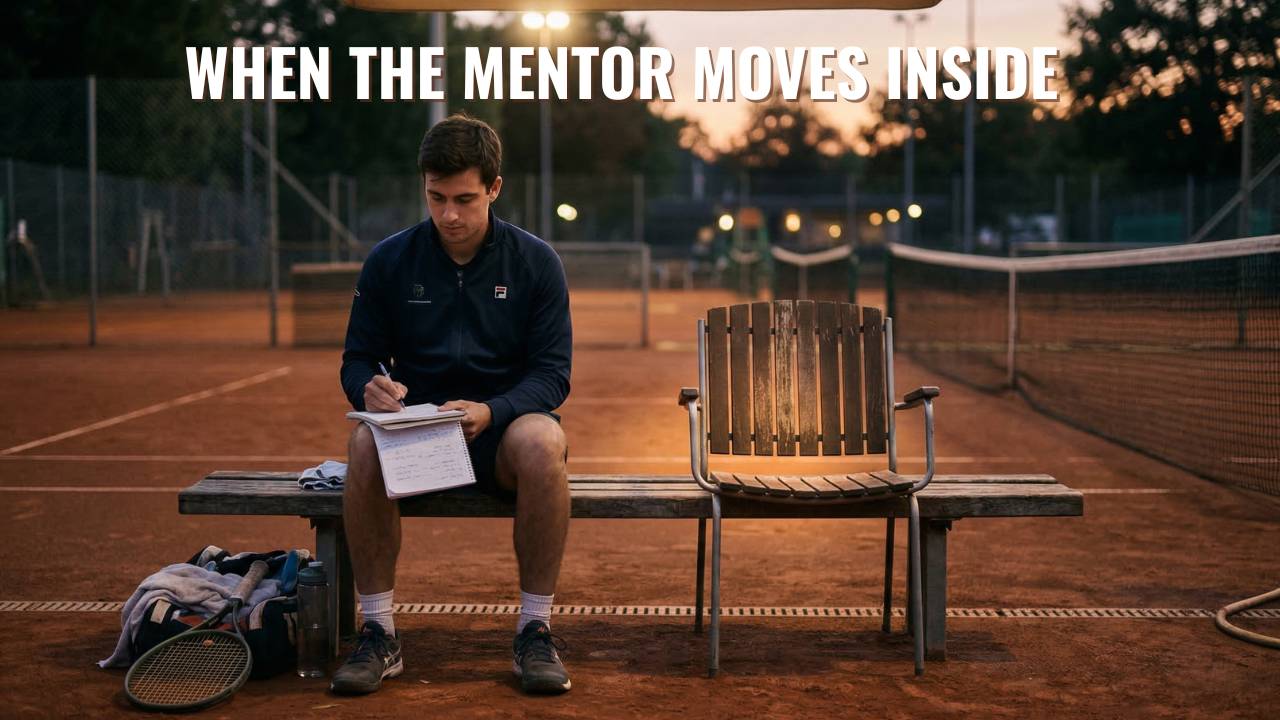
Human to the Power of AI — Essay Two
Most people assume the transfer of knowledge between a mentor and a learner happens during their conversations. The meeting is where the insight lives. The scheduled time together is where understanding gets built. That assumption is understandable and almost completely wrong. The most important moment in that kind of relationship does not happen during a conversation. It happens before one.
Michael Canavan was still bringing questions to the table. He still kept the notebook, still asked for time to work through what was in it, still walked through the same rhythm that had shaped his development since arriving at Midcourt Tennis Academy. But something about his relationship to those meetings had quietly shifted. Before requesting time to talk, he began asking himself the questions he knew would come once he arrived. He had been through enough of those exchanges to recognize the pattern. A situation from practice would be described. What he noticed before making the decision he made. What alternatives he had actually considered in the moment rather than reconstructed in hindsight. What assumptions had operated underneath the choice without announcing themselves. He knew that bringing a question into that room meant leaving with several others. So he began running the process himself before walking through the door. By the time the conversation started, much of the work had already happened.
That is the actual mechanism of mentorship. Not the transfer of information, not the accumulation of answers, but the gradual migration of a questioning pattern from one person's mind into another's. The knowledge transfer was never the point. What transferred was the architecture of questioning itself, and the moment it moved inside Michael was the moment it became durable.
This process operates across every domain that develops serious judgment. Athletes hear a coach's voice while competing in a situation the coach never specifically addressed. Writers hear an editor's questions while revising a paragraph the editor has not yet seen. Musicians practice alone and still hear guidance from a teacher they may not have worked with in years. The external voice becomes internal architecture not through a single conversation or a particularly memorable exchange, but through accumulated repetition of the same questioning pattern until the learner no longer needs the external source to run it. Most people who have experienced this cannot fully describe when it happened. The process does not announce itself. It arrives quietly through enough cycles of encounter, reflection, and return.
Educators have a term for what produces that architecture. Recursive learning describes the cycle where an experience generates questions, those questions shape reflection, and that reflection reshapes the next attempt. Each cycle improves judgment by a small amount. Over time those small improvements compound into something that looks, from the outside, like intuition. What it actually is, is accumulated structure. The learner has internalized a way of examining situations that now operates automatically, without requiring a conscious decision to deploy it. A meticulous thinker who spent months filling a notebook with questions and then working through those questions with someone patient enough to respond with more questions is a person whose reflective architecture is being constructed one session at a time.
The apprenticeship model that shaped most skilled professions was built around exactly this process. A learner observed someone further along the path, attempted to replicate what they saw, fell short, reflected on why, and brought the question back to the mentor for another round of interrogation. The model worked. It produced craftsmen, scientists, physicians, and coaches capable of judgment that could not be reduced to procedure. The knowledge lived in the quality of their questions, not the volume of their answers.
The limitation of that model has always been architectural rather than philosophical. Human mentors have finite availability. They carry other responsibilities, serve multiple learners, and operate within the constraints of time and attention that govern all human relationships. They forget specific details. They cannot maintain continuous awareness of every situation a learner encounters between sessions. The relationship eventually ends, and whatever questioning architecture has transferred by that point is what the learner carries forward. Whatever has not yet transferred is simply gone.
This is the structural gap into which artificial intelligence introduces something genuinely new. Not new thinking. Not better judgment. Not a replacement for the lived experience that gives a mentor the ability to recognize what matters inside a complex situation. What it introduces is a change in the architecture of availability. The questioning partner does not have to disappear when the session ends. It does not carry competing obligations into the conversation or maintain awareness of twenty other learners simultaneously. When a system has absorbed enough of a person's frameworks, language, and patterns of reasoning, it becomes capable of participating in the same kind of interrogation that once required another human being present in the room. The learner can describe a situation, explain what they observed and what decision they made, and receive questions designed to expose the structure of their thinking rather than simply evaluate the outcome.
That dynamic begins to resemble what Michael discovered before those meetings. The conversation can happen before the conversation. The reflection does not have to wait for scheduled time with another person. The architecture of questioning that a good mentor builds over months of deliberate exchange can now remain externally present rather than requiring complete internalization before it becomes accessible.
The distinction between those two things matters more than it might appear. When questioning architecture exists only inside the learner, it is subject to everything that degrades internal processes under pressure. Fatigue distorts it. Ego protects against it. The urgency of a competitive environment compresses the space it needs to operate. The mentor's voice gets quiet exactly when it is most needed. An external architecture does not carry those vulnerabilities in the same way. It is available when the pressure is highest, when the situation is most confusing, when the learner's own internal process is least reliable.
This is not an argument that artificial intelligence replaces human mentors. The lived experience that produces genuine judgment cannot be trained into a system through text. A mentor who has coached through difficult situations for decades carries something that cannot be fully translated into frameworks and terminology, no matter how carefully the translation is attempted. What can be translated is the questioning structure. The habit of asking what was noticed rather than what happened. The practice of separating what was assumed from what was observed. The discipline of identifying what other interpretations might have been available before committing to the one that felt most obvious. Those patterns can be preserved, made available, and applied to new situations long after the original relationship has ended.
The coaching environments responsible for developing judgment in young people are not yet seriously exploring what this makes possible. Most of the conversation about artificial intelligence in sport still operates at the surface of the work, focused on technique analysis, performance data, and pattern recognition in physical execution. Those applications are real and may be useful. But the deeper layer of development lives in the architecture of reflection that shapes how athletes and coaches interpret what they experience, and that layer has always depended on mentors who ask better questions. The next stage of that work depends on learning how to design environments that preserve those questions, make them continuously available, and allow the architecture of good thinking to outlast the relationships that originally built it.
Next: Why most people abandon AI thinking partners before the collaboration actually begins, and what that says about how we misunderstand the learning curve.
Never Miss a Moment
Join the mailing list to ensure you stay up to date on all things real.
I hate SPAM too. I'll never sell your information.
