When the Thinking Partner Does Not Leave
Mar 15, 2026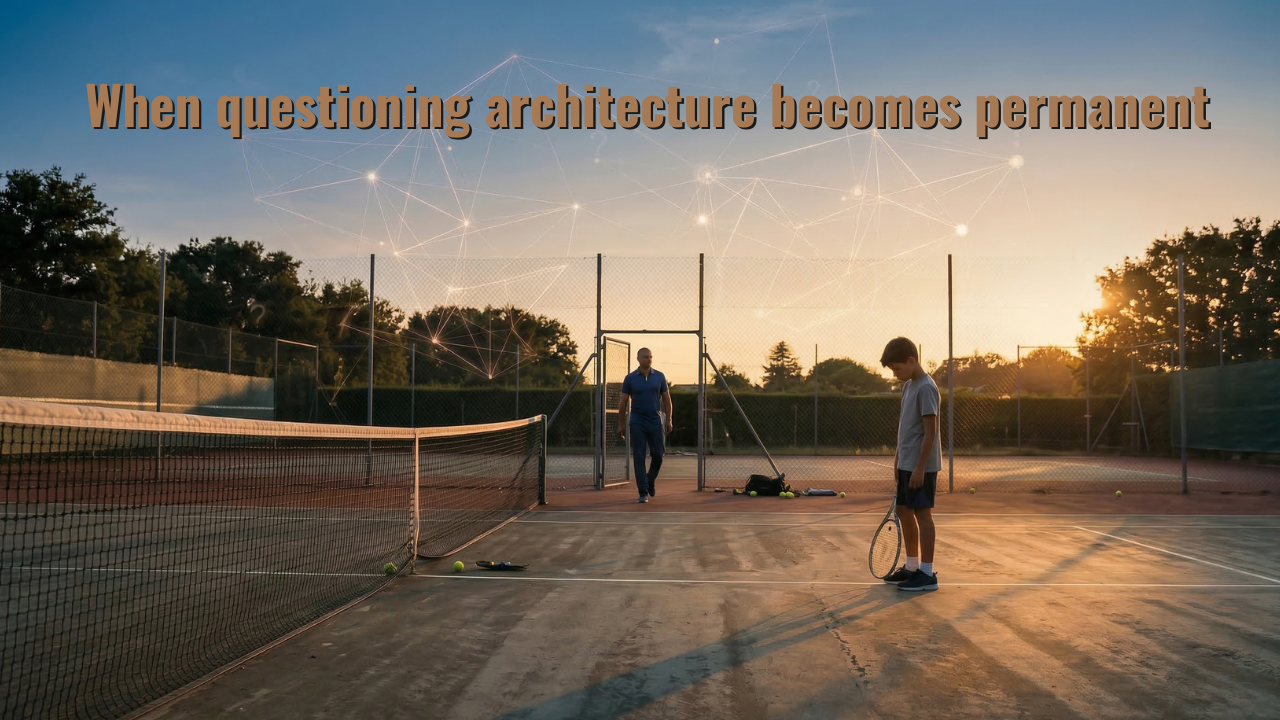
Human to the Power of AI — Essay Five
Mentorship has always contained a structural limit that most people accept without ever examining it closely. The relationship ends. A coach works with a player for several years and then the player moves to another program. A teacher guides a student through a critical stage of development and then the semester turns over. A young coach fills notebooks with questions and spends months in conversation with someone more experienced, until the rhythm of those conversations becomes internalized and the meetings gradually stop. What remains is whatever architecture managed to transfer before the relationship changed.
The learner carries that architecture forward and continues without the mentor present, standing eventually with the questions they have learned to ask themselves and nothing else to fall back on.
That structure has shaped development environments for as long as mentorship has existed. Not because it is the best possible structure, but because it was the only one available. The limitation was accepted the way most structural constraints get accepted, without much examination, because nothing in the environment suggested it could be otherwise.
The moment that defined Michael Canavan's development as a coach was precisely this dynamic playing out correctly. He had internalized the questioning architecture from those conversations well enough that he began running the process himself before walking into the room. He knew what was coming. He knew that describing a situation would produce questions about what he had actually noticed before making the decision, what alternatives had been visible in the moment rather than reconstructed afterward, and what assumptions might have shaped the choice without announcing themselves. He had absorbed the pattern thoroughly enough to apply it without a prompt. By the time the meeting started, the interrogation had already begun.
That is the mentorship mechanism working the way it is supposed to work. The questioning architecture has moved inside the learner's thinking and the learner no longer requires an external source to initiate the process. Most people who work with a skilled mentor long enough eventually reach some version of that point, and most of them experience it as a kind of arrival, a signal that the investment of time and attention has compounded into something durable.
What the feeling of arrival tends to obscure is the fragility underneath it. Internal processes are not stable under pressure in the way they are during calm reflection. Fatigue distorts them. Ego protects against them. The compression that occurs when decisions must be made quickly collapses the space that careful questioning requires. Anyone who has spent serious time in development environments has watched this happen. A player who can examine their own decisions with clarity and honesty in the calm of a post-match conversation stops examining those decisions in the middle of competition. A coach who asks excellent questions during planning sessions reverts to reactive instinct when a match is not going well. The questioning architecture has not disappeared. It has become harder to access at the exact moments when access matters most. That is not a character failure. It is a structural vulnerability that traditional mentorship has never had a reliable way to address, because the mentor is rarely present when the pressure arrives.
This is where artificial intelligence introduces something genuinely new, and it is worth being precise about what that something is. The technology does not replace the lived experience that allows a mentor to recognize what matters inside a complicated situation. The frameworks that make good questions possible still have to be built through years of deliberate observation. The raw material of judgment still comes from watching players operate under pressure, noticing how students struggle with specific ideas at specific stages, and accumulating the pattern recognition that only repeated exposure to real environments can produce. None of that changes. What changes is what happens to the architecture produced by that work.
For the first time it becomes possible for the structure of a mentor's thinking to remain available outside the moments when the mentor is physically present. A learner can describe a situation and encounter questions that resemble the ones a skilled mentor would ask, not because the machine understands the world the way a human mentor does, but because it has absorbed the frameworks, distinctions, and reasoning patterns that define how that mentor interprets situations. The thinking partner does not leave when the meeting ends. The questioning architecture that once existed primarily inside the mentor's mind, transferred partially to the learner through repeated exchange, and faded whenever either party was unavailable, can now persist as something closer to infrastructure.
That reframe matters more than it might initially appear. The arrival of artificial intelligence inside learning environments is less about intelligence than it is about memory. Human mentorship has always been powerful and fragile simultaneously. Powerful because it transfers structures of thought that shape judgment for decades. Fragile because those structures exist mostly inside people rather than inside the environments where development takes place. When the mentor is no longer present, the architecture lives only in what the learner managed to internalize, which is always partial and always vulnerable to the conditions that degrade internal processes under pressure. Artificial intelligence offers a way to anchor some of that architecture outside the individuals who originally created it, making it available to the learner at the moments when their own internalized version is least reliable.
The developmental loop that the previous essays traced through Michael's story has always depended on the mentor being available for the examination stage: encounter a situation, examine the reasoning underneath it, return to the environment with slightly better judgment. When the mentor is not present, the loop shortens. The learner experiences something and attempts to reflect on it alone. Sometimes that reflection produces genuine insight. Often it produces a version of events that confirms what the learner was already inclined to believe, because the pressure to protect a working interpretation of events is always stronger than the pressure to dismantle one. The internal questioning voice, when it exists at all, competes with every other demand on attention and emotional energy that the environment is generating simultaneously.
What becomes possible when the thinking partnership is permanent is that the examination stage of that loop no longer depends on timing, proximity, or the availability of another human being. The learner can return to the questioning architecture that shaped their development and run another cycle of examination before the next experience arrives. The loop continues operating even when the original conditions that created it have changed. In coaching environments, in classrooms, in any domain where judgment is built slowly through repeated encounters with situations that cannot be reduced to procedure, that continuity represents a structural change in how development can be organized.
The most important caveat has been present in every essay in this series and it belongs here as well. None of this functions without the patient work that mentorship has always required. The architecture that an AI thinking partner can preserve still has to exist before it can be preserved. Someone has to observe carefully enough to develop frameworks that actually illuminate situations rather than simply organizing them. Someone has to articulate those frameworks with enough precision for another mind to engage with them productively. Someone has to be willing to return to difficult situations and examine what actually happened rather than protecting the interpretation that arrived first and felt most comfortable.
The tools have changed. The mechanism of development has not. What has changed is the structural possibility that the questioning architecture produced through that mechanism no longer has to live primarily inside the individuals who created it. It can begin to live inside the environments where learning actually happens. A coaching environment that has deliberately built and preserved a questioning architecture does not lose that architecture when a mentor moves on, when a player ages out, or when the relationship that produced the architecture ends for any of the ordinary reasons that relationships end. The architecture persists and remains available for the next learner who enters that environment and needs the same interrogation that shaped every learner before them.
That is not a prediction about technology. It is a description of what becomes structurally possible when the fragility that has always been built into mentorship relationships is no longer an unchangeable feature of the learning environment. The cycle of experience, reflection, and evolution has always worked when the conditions for it were in place. What this series has been building toward is a name for what those conditions look like when they are designed intentionally rather than inherited through circumstance: AI-native mentorship. Not mentorship assisted by AI, and not AI substituting for mentorship, but a learning architecture built from the ground up around the permanent availability of questioning structure. The question that this series has been circling from the beginning is a structural one: what changes when those conditions no longer depend on whether the mentor happens to be in the room.
This essay completes the first arc of the series. The next arc examines what it actually looks like to build that architecture intentionally, inside the environments where development happens.
Never Miss a Moment
Join the mailing list to ensure you stay up to date on all things real.
I hate SPAM too. I'll never sell your information.
