When Trying Stops Being Enough
Feb 10, 2026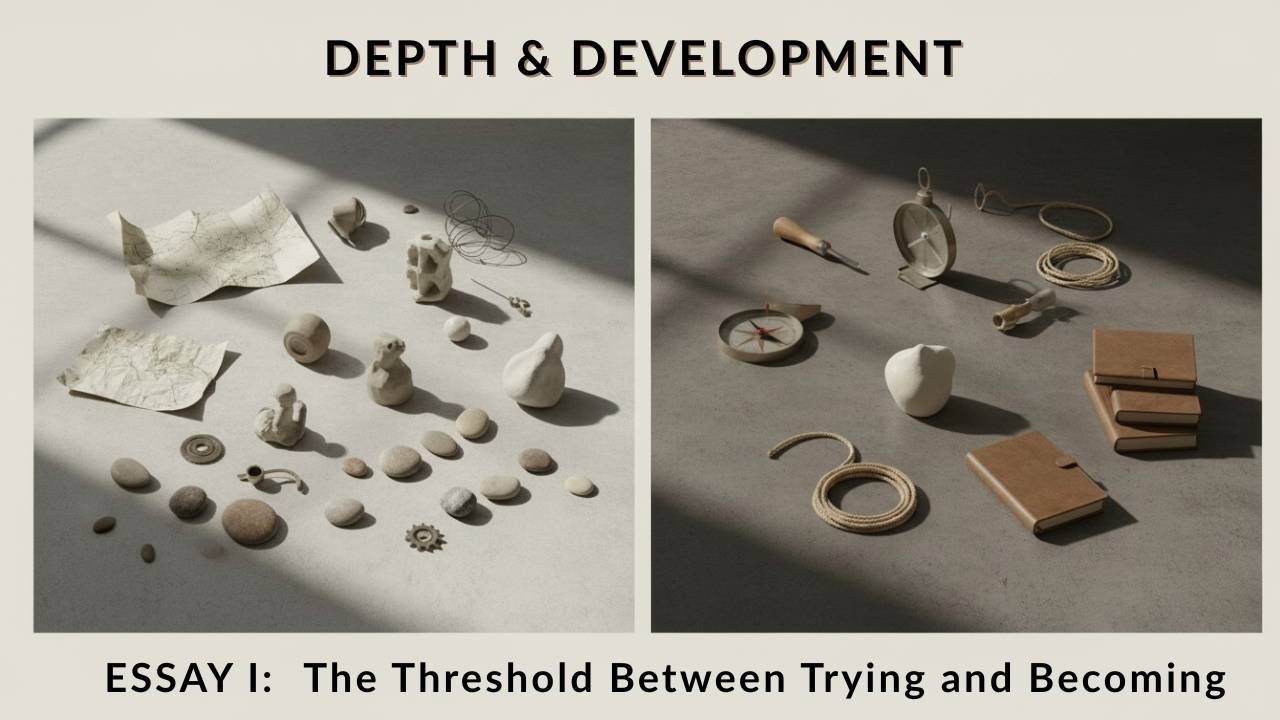
Walk into any youth sports facility on a Tuesday afternoon and you will see the same scene playing out across twenty different courts or fields. Kids showing up. Kids participating. Kids doing what they are told, more or less, for the duration of the activity. Parents watching from the sidelines, half-engaged with their phones, checking the time. Everyone present. Nobody quite committed. This is what trying looks like when it becomes permanent residence instead of temporary housing.
The word "trying" has come to occupy sacred ground in youth development conversations. Adults defend it as healthy exploration. They call it balance. They invoke fear of burnout, overspecialization, lost childhoods. And in early childhood, they are right. Sampling is how young people discover what fits. But what almost nobody discusses is the moment when trying stops being exploration and starts being avoidance. That moment exists. I have watched hundreds of young people reach it. Most never cross it.
Here is what changes when someone stops trying and starts becoming. Standards appear where preferences lived. The twelve-year-old who wants to find out how good she can get at something suddenly cares whether her footwork is correct, not just whether practice felt good. Tradeoffs become real. Time stops being something to fill and starts being something to protect. Feedback stops being encouragement and starts being information. Effort becomes visible to everyone, including the person doing it. This is the threshold that separates activity from development.
I had a student years ago named Estelle Liang. Twelve years old. Somewhere in the middle of a lesson, she stopped mid-drill and said something I did not expect. "These lessons teach me more about life than about tennis." I remember feeling a flicker of concern when she said it, like maybe she was telling me she wanted to quit. What I realized later was that she had just crossed the line. She was no longer trying tennis to see if she liked it. She was using tennis to become someone. The disguise was off.
That clarity is what trying never produces. Trying is built on the idea that commitment can wait, that seriousness will arrive later on its own, that depth is something reserved for teenagers or college students. It will not arrive on its own. Seriousness has to be invited. It has to be modeled. It has to be protected from the adult impulse to rescue discomfort before the young person learns what discomfort teaches.
The problem is not that kids are trying too many things. The problem is that systems never teach what comes after trying. Development programs advertise excellence without obligation, progress without consequence, improvement without friction. Parents sign up because it sounds reasonable. Coaches deliver it because pressure makes parents uncomfortable. Everyone stays busy. Nobody becomes capable.
What I am describing is not specialization or year-round single-sport focus. What I am describing is learning how to be serious about something. That skill transfers. A young person who learns how to commit deeply to one pursuit learns how to commit deeply to many things over time. They learn how to manage competing obligations. They learn how to honor standards even when convenience argues against it. They learn what it feels like to persist past the point where trying would have allowed them to quit.
I made a mistake with my youngest daughter years ago that taught me this in reverse. She was playing elite soccer. The club wanted exclusivity. No other sports. No outside commitments. I could have engineered an AND solution. I had done it before with other families. Instead, I pulled her out entirely rather than force the choice. I thought I was protecting multiplicity. What I was actually doing was teaching her that depth and breadth cannot coexist under real pressure. That was wrong. Depth is what makes breadth possible, not what prevents it.
Here is what depth actually teaches. It teaches that identity is shaped by decisions, not by accumulated experiences. It teaches that improvement is an active process, not something that happens to you if you show up long enough. It teaches that aspiration carries responsibility, and that responsibility is not the same thing as burden. These lessons do not transfer from trying. They transfer from becoming.
Adults say they want resilience, discipline, confidence, and grit in young people. Those words appear in mission statements everywhere. But none of those traits develop during the trying phase. They develop only after commitment has been made and tested under conditions that matter. Without that test, the traits stay theoretical.
The irony is that many adults fear this transition will narrow a young person's world. They picture the burned-out teenage athlete or the overscheduled student who sacrificed childhood for rankings. That fear is real, but it confuses depth with obsession. What actually narrows a life is never learning how to take anything seriously. The person who spends eighteen years sampling without committing does not end up well-rounded. They end up without the skill to build anything that lasts.
I had another student named Natalie Frazier-Jenkins. When she was nine years old, a ball came to the doubles alley on the deuce side during a lesson. It was going out. She did not run for it. After the point, I told her she would have opportunities to hit balls like that one, but she would never have an opportunity to hit that particular ball ever again. That was more than twenty years ago. When she got offered a chance to play in the Pan Am Games but had a company internship scheduled at the same time, she called the company to ask what to do. They told her to go play, that she could always work later. And sitting there making that decision, she thought about the ball in the doubles alley when she was nine. That is what depth does. It turns a single moment of clarity into a durable pattern that operates across decades and contexts.
The shift from trying to becoming is not about the activity itself. It is about the young person deciding that finding out how good they can get at something matters more than staying comfortable. Once that decision is made, the role of every adult in the system changes. The parent is no longer managing a schedule of options. The coach is no longer running a feel-good experience. The environment stops being about exposure and starts being about standards. This is not harshness. This is honesty.
Most youth development conversations avoid this moment entirely. They keep everyone in trying mode until it is too late to build anything. The message becomes that effort is optional, standards are negotiable, and seriousness is something other people do. Then we act surprised when eighteen-year-olds arrive at college without knowing how to commit to hard things or manage their own development.
The decision to become something is the first deep developmental lesson. Everything else builds from there. Without it, you get motion without direction. You get participation without transformation. You get years of investment that produce very little return because the foundation was never built.
This essay is not arguing against exploration. It is arguing against permanent exploration. At some point, the question has to shift from "What do I want to try?" to "What do I want to become?" When adults help young people make that shift instead of preventing it, development starts. Not before.
Everything in the essays that follow depends on understanding this threshold. There is trying. Then there is becoming. The space between them is where most potential gets lost.
Never Miss a Moment
Join the mailing list to ensure you stay up to date on all things real.
I hate SPAM too. I'll never sell your information.
