Where Perception Gets Recorded
Feb 23, 2026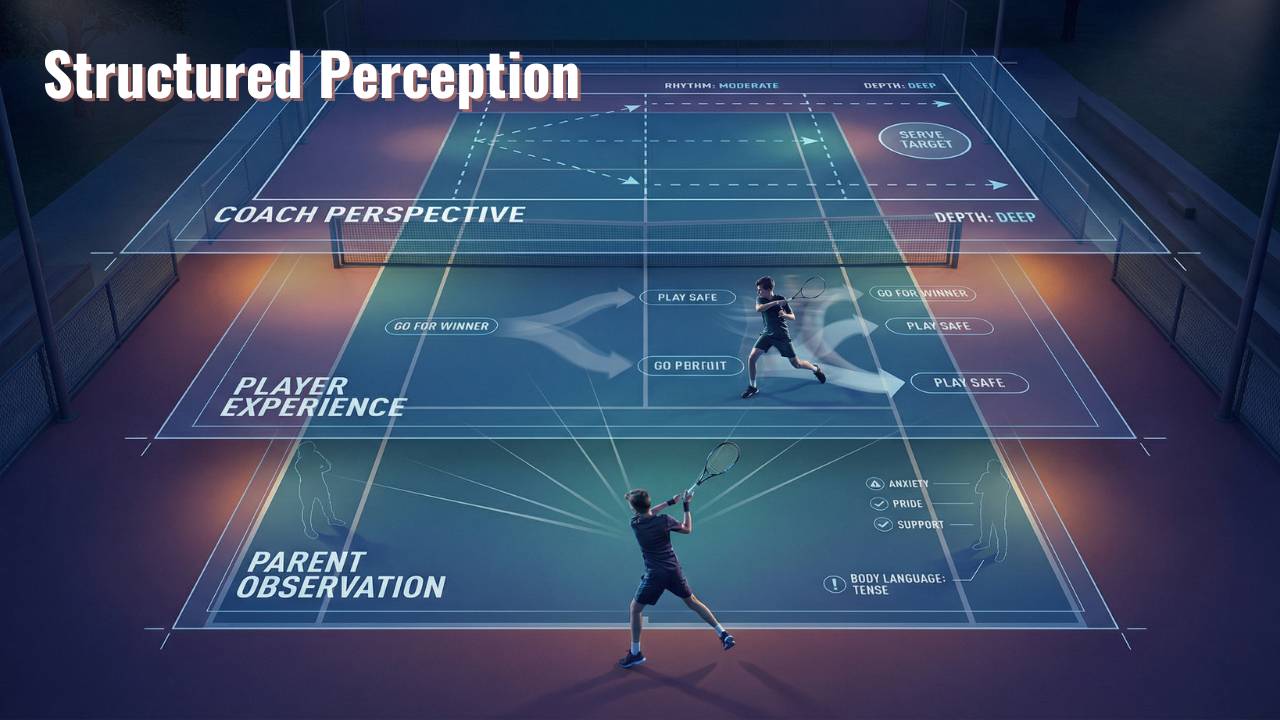
Architecture begins the moment perception stops living only inside people's heads.
In most development environments, interpretation evaporates as quickly as it forms itself. A player loses on Tuesday. The coach carries an impression of what broke down. The parent walks away from the stands with a different impression altogether. The player carries an internal experience that matches neither adult's interpretation fully. By Thursday, practice begins again. By Saturday, another match produces fresh emotion. Whatever was understood on Tuesday has already been distorted by memory, urgency, and reaction to new events.
If calibration depends on people remembering accurately, it will fail. The constraint is not that people forget to pay attention. Human memory reorganizes itself under pressure. When three people reorganize independently, alignment collapses. This is why systems that rely on recall alone cannot sustain calibration no matter how committed everyone is to making it work.
Structured perception answers one question first. What exactly gets recorded so that Tuesday does not disappear by Saturday?
Tuesday: The Match
A 13 year old loses 6-3, 6-4. From the outside, the result looks straightforward enough. The parent sees frustration showing up after long rallies. The coach notices hesitation when tempo increases. The player reports feeling rushed and unsure whether to attack or reset in those moments.
In a typical system, those impressions get discussed informally and then dissolve into whatever narrative feels most urgent by the time the next practice session begins. The only durable record that survives is the scoreline itself. Nothing about the actual breakdown gets preserved in a way that makes targeted work possible later.
Structured perception captures something fundamentally different. Within a defined window after the match ends, three interpretations get recorded separately before memory starts reorganizing what happened.
The coach logs what was observed tactically. Not just that the player hesitated, but in which patterns hesitation appeared most clearly. Was it after serve returns specifically? During neutral exchanges when the rally rhythm stabilized? Only when the opponent changed height and spin suddenly? The coach records interpretation of pattern, not just outcome of points.
The player records what was experienced internally during those same moments. Did the hesitation feel like confusion about pattern recognition? Did it feel like fear of missing when the moment mattered? Did it feel like physical fatigue making decision speed slower than usual? The language does not have to be sophisticated or technical. It has to be authentic to what the player actually experienced.
The parent records what was visible from their vantage point without coaching expertise. Did body language shift after specific sequences? Did emotional regulation change after the coach gave cues between points? Did tempo visibly alter how fast decisions got made?
Three perspectives. Same match. Captured systematically.
Thursday: The Lesson
By Thursday, practice begins again. In most systems, Tuesday is already being reconstructed through whatever narrative carries the most emotional weight at that moment. If the player is discouraged, Tuesday becomes proof of fundamental weakness. If the coach is frustrated, Tuesday becomes proof that the player is not working hard enough. If the parent is anxious, Tuesday becomes evidence that the current approach is failing.
Structured perception prevents reconstruction by preserving the original interpretation. The coach reviews Tuesday's logged patterns before designing Thursday's session. Instead of saying the player needs to be more confident as if confidence is the actual problem, the coach can say hesitation showed up specifically when the opponent increased height in neutral rallies and we are training recognition of that specific transition today.
The player sees their own words from Tuesday still intact. They are reminded that the feeling was uncertainty about options available in that moment, not fear of competition itself or lack of fighting spirit. That reframing changes what practice is actually addressing.
The parent does not need to intervene emotionally or guess at whether practice is targeting the right thing because they can see that Thursday's session is explicitly addressing the breakdown identified on Tuesday. Anxiety reduces because action aligns with recorded perception instead of competing with it.
Practice becomes precise targeting instead of reactive adjustment based on who remembers what most forcefully.
Saturday: The Next Match
On Saturday, a similar opponent appears. The player loses again, but something changes in how the loss looks when examined systematically. Hesitation appears less frequently than it did on Tuesday. When it appears, recovery happens faster than it did before. The player is beginning to recognize the pattern earlier even though execution is still lagging behind recognition.
Without structured perception, this match might be labeled another loss and folded into a narrative about stagnation or insufficient progress. The scoreline looks the same as Tuesday. With structured perception, Saturday gets logged against Tuesday's baseline in ways that make invisible progress visible.
Did hesitation frequency decrease compared to Tuesday? Did internal experience shift from complete confusion to late recognition of the pattern? Did emotional recovery accelerate even though execution mechanics are not yet fast enough to win the point? These questions become answerable because Tuesday's interpretation was preserved accurately enough to make comparison meaningful.
Learning becomes visible even when the scoreboard does not reward it yet. Perception accumulates in ways that compound understanding rather than resetting every time a match ends.
What Makes This Different From Notes
Coaches often keep notes about their players. Academies send progress reports to parents regularly. Parents text observations to each other after matches. None of that guarantees structured perception by itself.
What makes structured perception different is five properties that must exist together for the system to function under pressure.
First, it captures interpretation and not just outcome. Scorelines are insufficient. Shot percentages are insufficient. The system records what each perspective believed was happening beneath the surface of those numbers.
Second, it captures interpretation quickly before reconstruction distorts memory. The window matters significantly. Waiting two weeks to capture interpretation means capturing a reconstructed memory, not the original perception.
Third, it preserves perspectives separately before integrating them. The coach does not overwrite the player's interpretation by translating it into coaching language first. The parent does not absorb the coach's language prematurely and lose their own observation. Each viewpoint exists intact long enough to be compared rather than merged too quickly.
Fourth, it holds perception in a format that survives urgency. A shared digital system accessible to all three parties. A structured template that forces specific information to be recorded. A standardized reflection field that makes comparison possible across weeks and months. Something retrievable for decisions and comparable for pattern recognition.
Fifth, it remains accessible to all relevant parties without creating surveillance relationships. Not as the coach monitoring what parents think, or parents checking what the coach wrote, but as shared reference that makes calibration possible. When all three perspectives are visible to everyone involved, interpretation can integrate instead of competing.
Without these five properties working together, notes remain anecdotal rather than systematic. With them, perception becomes infrastructure that development can build on top of reliably.
Where It Lives Now
Structured perception does not belong to a single academy or program. It belongs wherever development must survive pressure without losing direction.
In traditional environments, it can be bolted onto existing training systems through disciplined reflection protocols and shared digital capture tools. In AI native environments, it becomes foundational infrastructure that continuously holds and organizes perspective across time without requiring human memory to sustain it.
The power is not located in software itself. It is located in externalizing interpretation systematically and reviewing it before making adjustments to what gets worked on next. If perception is not externalized, it is vulnerable. Technology makes that externalization scale.
Why This Changes Everything
When perception is recorded reliably enough that it survives pressure, three things happen immediately without requiring additional intervention.
Emotional volatility decreases because action references pattern rather than the last result's emotional impact. Parents stop panicking when losses happen because the system shows learning that the scoreboard does not reflect yet. Players stop internalizing outcomes as identity statements because the recorded interpretation shows breakdown as mechanical rather than personal.
Practice precision increases because breakdowns are targeted systematically rather than guessed at based on who remembers what most forcefully. The coach stops working on confidence when the actual problem is pattern recognition speed. The player stops getting instruction that does not match their internal experience of what is breaking down.
Trust stabilizes because everyone can see what is being worked on and why. The parent does not need to fill interpretive gaps with anxiety about whether the coach understands their child. The coach does not need to defend priorities constantly because the logged interpretation shows continuity. The player does not need to manage everyone else's uncertainty about whether development is on track.
Perception stops drifting from one emotional narrative to another as urgency shifts. That stability is what makes everything else possible.
What This Enables
Structured perception solves a problem that sits at the heart of systematic learning. For years I have used a framework called IEDE. Intention, Experience, Debrief, Evolution. It describes how people actually learn from doing rather than from being told. You set intention before acting. You experience what happens under pressure. You debrief what occurred. You evolve based on what the debrief revealed.
The constraint has always been the Debrief phase. Under pressure, memory reorganizes itself too quickly for debrief to be accurate. By the time you sit down to examine what happened, three different people have three different reconstructed memories competing for legitimacy. The coach remembers what they saw tactically. The parent remembers the emotional arc. The player remembers confusion or fear or frustration without being able to separate mechanical breakdown from personal failure.
When debrief operates on reconstructed memory instead of preserved perception, the entire IEDE cycle breaks down. Intention for the next cycle gets set based on faulty interpretation of the last cycle. Experience keeps producing the same patterns because nobody can see them accurately enough to target them. Evolution stops happening because learning depends on understanding what actually occurred, not what people remember occurring.
Structured perception is the infrastructure that protects debrief from that collapse. It captures interpretation before reconstruction begins. It preserves the three perspectives separately so they can be integrated rather than competing. It makes the rest of the learning cycle possible by ensuring that what gets examined matches what actually happened closely enough for accurate judgment to form.
This is why calibration and learning are not separate problems. They are the same problem approached from different angles. Calibration is about maintaining accurate perception under pressure. Learning is about converting accurate perception into capability that compounds over time. You cannot have one without the other. Structured perception makes both possible.
The Foundation For Integration
Structured perception is only the first requirement for systems that can sustain calibration under competitive pressure. Without it, integration becomes impossible because there is nothing stable to integrate across the different timeframes people operate within. Coaches think in quarters. Players think in matches. Parents think in seasons and years. These timeframes cannot stabilize when perception keeps resetting.
In the next essay, we examine how recorded perspectives get translated into shared reference before decisions are made about what to work on next. Structured perception holds what happened accurately. Integration determines what it means when three different people look at the same events through different lenses.
Architecture begins with recording perception reliably. It matures when translation between perspectives becomes systematic rather than hoped for.
This is Essay 7 of the Calibration Series. New essays publish each Monday.
Never Miss a Moment
Join the mailing list to ensure you stay up to date on all things real.
I hate SPAM too. I'll never sell your information.
