Why Coaches Need to Watch the Game
Aug 18, 2026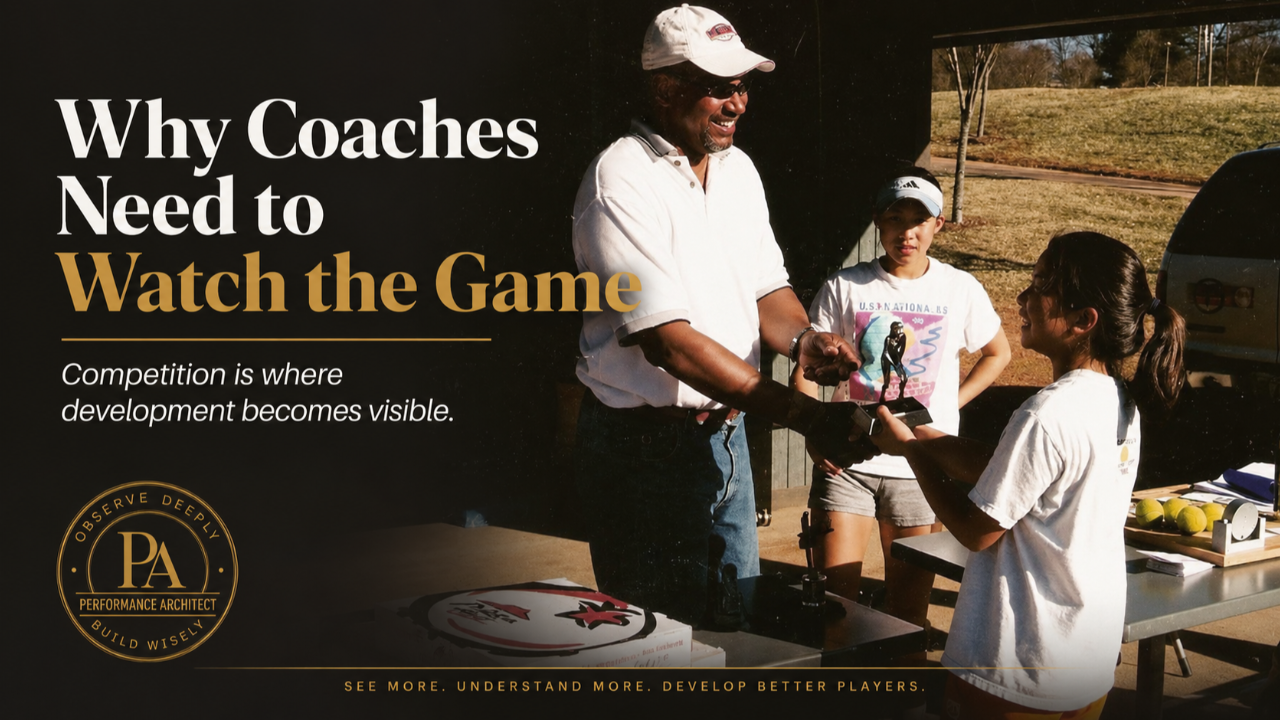
I cut my coaching teeth in Atlanta, in a market where junior tennis was highly competitive and a number of very good programs were chasing many of the same players. One thing was simply understood: coaches went to tournaments. If your players were competing, somebody from your program was probably there watching. Part of that was developmental. Part of it was probably defensive. If your coaches were never around when the kids competed, there was a good chance somebody else's coaches were.
When I moved to Charlotte in 2000, I found something very different. I'd go to tournaments with my players and often see almost no other coaches. My assumption then, and still today, is that most of it was economic. Weekends were valuable lesson time. A coach could spend Saturday and Sunday teaching private lessons and generating revenue, or spend those same hours driving to tournaments and watching kids play. Those two choices produce very different kinds of return.
I don't say that critically. I spent more than 30 years putting junior development near the masthead of who I was, and I know firsthand what that choice can cost the rest of a life.
But there is still a developmental trade being made when coaches don't see their players compete.
Practice Shows One Player. Competition Shows Another.
A lesson tells me a lot. Practice tells me more. I can see technical skill, movement quality, tactical understanding, attention, effort, and how a player responds to instruction. I can design situations and test different solutions. I can ask questions and watch a player solve problems. But none of that is the game itself.
Competition changes what matters. The player has to choose without being told. The opponent is solving problems back. The score changes risk. A missed shot has consequences. Something a player executed beautifully ten minutes earlier in warmup can disappear completely once winning starts to matter.
I saw that again this weekend at an L6 tournament at Courtyard Racquet Club in Austin. I've come to think of what competition produces as the most coachable moments available to a coach: points where pressure strips away whatever a player can perform on command and shows what they actually do when it counts. Practice can approximate pressure. It can't fully replace what a real opponent, a real score, and a real consequence do to a player's decision-making.
One of the players I watched that weekend, whom I'll call John Joseph, or JoJo for short, has plenty of tools. He can create shape on the ball. He can move. He has enough forehand to establish himself differently in points than he sometimes chooses to. But watching him compete revealed things that would be easy to misread if I'd only seen him practice.
He double-faulted frequently, and every second-serve miss I saw went into the net. None of that, by itself, is particularly profound. What got more interesting was what happened once the match turned competitive. Coach Rhiannon Evans had watched JoJo produce height and depth during warmup, but once the match began and he got more concerned with winning points, he started flattening the ball. A skill that was available to him didn't reliably transfer into competition, and that's a very different developmental problem than simply not possessing the skill.
The Match Gives the Lesson a Memory
The value of watching extends beyond diagnosing what went wrong. Not long after I moved to Charlotte, I met a 12-year-old named Teresa Wang at the North Carolina Closed in Raleigh. She was still green competitively, with good skills and parents who cared deeply about her development, but almost no tournament experience outside the state. What struck me, watching her compete that week, was that nobody responsible for her tennis seemed to be doing the same thing. Her parents noticed I was there, and it led to a conversation in the bleachers, then more conversations after that. Teresa became one of the founding players at Midcourt Tennis Academy. We stayed in touch long enough for me to know she went on to become a physician, though that part of her story belongs to her, not to anything I did. What I can say is that the conversation itself only happens because I was the one sitting in the stands.
I've thought about that story many times, because it points at something that became increasingly important in my coaching. When I watch a player compete, the match becomes shared material we can use later. I've come to think of this as shared competitive memory: a library of specific moments that a coach and a player both carry, and can reach for whenever the work calls for it.
Instead of standing in a lesson and saying, "You need to get farther around this forehand," I can say, "Remember the point at 4-3 when she floated that short ball and you stopped moving just before you got to it?" Now I don't have to invent context. The player remembers the opponent, the score, the movement, the decision, probably the emotion attached to it. Suddenly the thing we're working on isn't just another instruction coming from a coach. It's a solution to a problem the player has already lived through, and that changes learning.
The match creates a memory. The lesson attaches meaning to it. The next competition tests whether the player has evolved. That is the compounding effect. Every match you share with a player makes some part of the next lesson more meaningful, and every lesson gives the next match more developmental value.
Building the Library
For several years I spent a great deal of time traveling with Thai Kwiatkowski when he was young. I carried one of his family's credit cards in my wallet to handle tournament expenses. I often drove their Volvo XC90, with Thai young enough to sit in the back seat, watching Star Wars movies while we drove from tournament to tournament. But I wasn't only there to coach Thai. ReeRee Li was often playing many of the same higher-level events, and she and Thai would frequently warm up together. Other academy players would be competing at various levels of the same tournament, and once I was there, I tried to watch as many of them as I could. I believed that was part of my job.
What accumulated over all those tournaments was more than information about forehands, serves, or patterns. It was a shared competitive history.
"Remember what happened against that player in Mobile?"
"Remember when you stopped using the pattern in the second set?"
"Remember the match when your second serve held up even though you were nervous?"
Those references become developmental shortcuts. You don't have to explain every idea from scratch, because coach and player already share the experience being referenced. A coach who only sees a player in lessons never builds quite the same library, and the library does more than accumulate examples. It shows you change over time: what once fell apart under pressure starts to hold up, and a decision a player used to miss starts to happen on its own.
The Game Reveals Choices
This may be the part I value most. Practice allows a coach to see what a player can do. Competition reveals what the player chooses to do. Those are not always the same thing.
A player may own three forehand patterns in practice and use only one when nervous. Another may understand height and depth perfectly, then abandon both the moment winning starts to matter. A reset routine that shows up every time a coach calls for it can vanish completely once an opponent starts rushing the changeover. And a player might have a real answer for the short ball without ever recognizing that a short ball is coming.
Those are problems of perception, decision-making, confidence, intentionality, and transfer, and you can't fully diagnose them by feeding another basket of balls.
At Courtyard, one of the questions we kept returning to with players was some version of: what were you actually trying to do? That's a very different question than, "Did you win?" It connects intention to experience, and from there, the player and coach can debrief what happened and decide what should evolve. That's the IEDE process in its most natural environment.
Observation, Not Prescription
Watching a player compete doesn't mean the observer suddenly knows everything the player needs. When I sent my observations about JoJo to his primary coach, I deliberately described them as observations, not prescriptions, and that distinction matters.
His primary coach sees him far more frequently than I do. He knows the training history, the technical priorities, what's already been addressed, what JoJo responds to, and what fits inside the larger developmental plan. My job wasn't to swoop in after one tournament and redesign the player. My job was to add information. I could tell the primary coach what I saw. JoJo could describe what he experienced. Rhiannon could add what she noticed. The primary coach could weigh all of it against what he already knew and decide whether any of it belonged in the training plan.
That process respects the primary coach while increasing the amount of useful information available to the developmental system, and it's also part of what I want Beyond the Card to provide. A primary coach can't reasonably be at every tournament. Nor should we pretend there's no personal cost when coaches spend every weekend traveling with players. But someone can be there to observe, to debrief, and to transfer what's useful back to the people responsible for what happens next. Otherwise, a surprising amount of learning simply disappears.
It Is Still a Game
During one of the conversations this weekend, I found myself coming back to something that seems ridiculously obvious. It's one thing to practice and have lessons and all that, but it's a game.
Imagine teaching someone to play cards by spending nearly all your time practicing how to shuffle, deal, hold the cards, and organize the deck, but rarely sitting down to watch them actually play. At some point you'd wonder whether the training environment had drifted apart from the thing it was supposedly preparing them to do.
Junior tennis can drift into the same problem. We spend enormous energy teaching players how to hit balls: building practice environments, prescribing drills, correcting technique, talking strategy, working on mindset. Then the player goes somewhere else on the weekend and plays the actual game. If the people responsible for development rarely see that game, an important part of the loop is missing.
Competition isn't simply where development gets graded.
It is where development becomes visible.
And if we're serious about helping players develop, we need some reliable way to watch the game they're actually being trained to play.
Written with Reggie, Claude, Gemini, Otter, and 64+ trips around the sun.
Never Miss a Moment
Join the mailing list to ensure you stay up to date on all things real.
I hate SPAM too. I'll never sell your information.
