Why Our Learning Environments Forget
Mar 16, 2026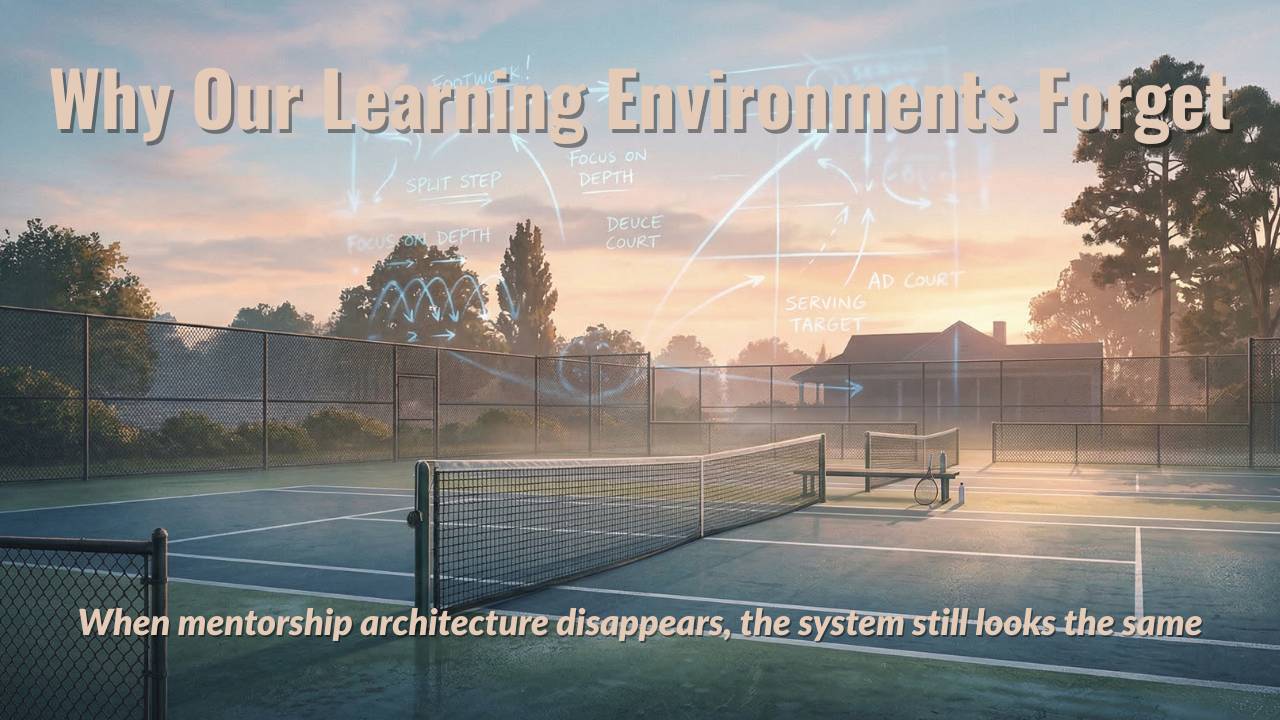
Human to the Power of AI — Bridge Essay
The first arc of this series traced a simple mechanism through an ordinary story. A young coach named Michael Canavan showed up with a notebook full of questions. Over time the rhythm of those conversations changed. The questions he brought became more precise. The answers he expected became less important than the questions he knew would come back at him. Eventually he began asking those questions himself before the meeting started, which meant the mentor's questioning architecture had moved inside the learner. That cycle, encounter a situation, examine the reasoning underneath it, return to the environment with slightly better judgment, has shaped the development of skilled practitioners in every domain that depends on interpretation rather than procedure. The details of the work differ across coaching, teaching, medicine, leadership. The mechanism does not.
But if you look closely at the environments where development actually happens, something strange becomes visible. The architecture that mentorship produces rarely survives the environment that produced it.
Consider how development environments typically change over time. A coach builds a program and spends years refining how players interpret situations under pressure. The program produces thoughtful athletes and young coaches who have internalized those questioning patterns. Eventually the coach moves on, retires, or shifts roles. The courts remain. The training schedule stays intact. The drills and practice structures persist because they were always the visible part of the system, the part that could be documented and handed to whoever came next. But the questioning architecture that once animated those activities fades surprisingly quickly, often before anyone notices it has started to go.
The same pattern appears in classrooms. A teacher develops a way of guiding students through difficult concepts. The questioning rhythm becomes familiar to the students who spend enough time in that environment. When the teacher leaves, the curriculum stays but the interpretive structure that once made the curriculum come alive slowly disappears. It appears in organizations as well. A founder builds a culture where certain kinds of questions shape decisions. New employees absorb those habits through proximity and repetition. As the organization grows and direct influence fades, the formal processes remain while the interpretive habits that once guided them become harder to recognize, then harder to describe, then simply absent. In each of these cases the surface of the environment is preserved. The architecture underneath it is not.
This fragility is not the result of neglect or incompetence. It is a structural feature of how mentorship has always worked. The architecture that mentorship transfers lives primarily inside people. It exists in the way a mentor frames a situation, in the distinctions they make between events that look similar from the outside, in the questions they ask when something does not look quite right. Those structures are learned through conversation, observation, and repeated exposure to real environments. A drill can be written down. A lesson plan can be documented. A curriculum can be archived. Questioning architecture does not transfer that way. It emerges gradually through interaction and disappears just as gradually when that interaction ends.
This is one reason development environments so often appear stable while quietly drifting from the principles that made them effective. The surface of the system is preserved while the deeper architecture that guided interpretation is not. A tennis academy may run the same practice structure for years while the questions coaches ask during those practices slowly change character. A classroom may use the same curriculum while the interpretive habits that once shaped discussion gradually lose their precision. An organization may preserve its formal processes while the reasoning patterns that once informed those processes become diluted across too many people who learned them secondhand. The people inside the system often sense that something has changed but cannot describe the change. The practices look familiar. The results feel different. What has disappeared is not the visible structure. It is the invisible architecture of how situations were read.
Once that pattern becomes visible, a second realization follows. The fragility of mentorship architecture has always limited how learning environments can evolve across generations. Every cohort of practitioners must rebuild some portion of the interpretive structure the previous generation developed. The most successful environments slow that erosion by maintaining sustained proximity between experienced mentors and new learners, which is precisely why apprenticeship models have persisted across so many domains for so long. But even the strongest mentorship cultures eventually face the same limitation. When the mentors leave, the architecture leaves with them. The environment preserves the surface of the system. It cannot easily preserve the interpretive structures that made the system work.
That limitation has been accepted for centuries because there was no obvious alternative. The architecture of questioning lived inside human relationships, and human relationships are inherently temporary. The first five essays in this series examined what that architecture is, how it transfers, why it fails to transfer when the learning relationship is misunderstood or abandoned too early, what it takes to make it visible, and why its durability changes when the thinking partner does not have to leave. The final essay named the possibility that emerges from all of that: AI-native mentorship. Not mentorship assisted by AI as an add-on tool, but a learning architecture built around the assumption that questioning structure can persist beyond the relationships that originally produced it.
That possibility changes the design question for learning environments in a way that the previous arc only began to touch. For most of human history, mentorship architecture could only live inside relationships. Learning environments were therefore built around proximity to experienced practitioners. The environment facilitated interaction but could not preserve the interpretive structures that interaction produced. If those structures can now persist outside the individuals who created them, the environment itself can begin to carry that architecture forward across time and across the transitions that have always caused it to disappear.
The challenge is no longer simply how to deliver instruction or organize practice. It becomes how to build environments that deliberately preserve and extend the questioning architectures that make development effective in the first place. That is the design question the next arc of essays takes seriously.
The next arc examines what those environments actually look like when they are built with the mechanism in mind from the beginning.
Never Miss a Moment
Join the mailing list to ensure you stay up to date on all things real.
I hate SPAM too. I'll never sell your information.
