Young Coaches Have Limitless Potential
Jul 03, 2026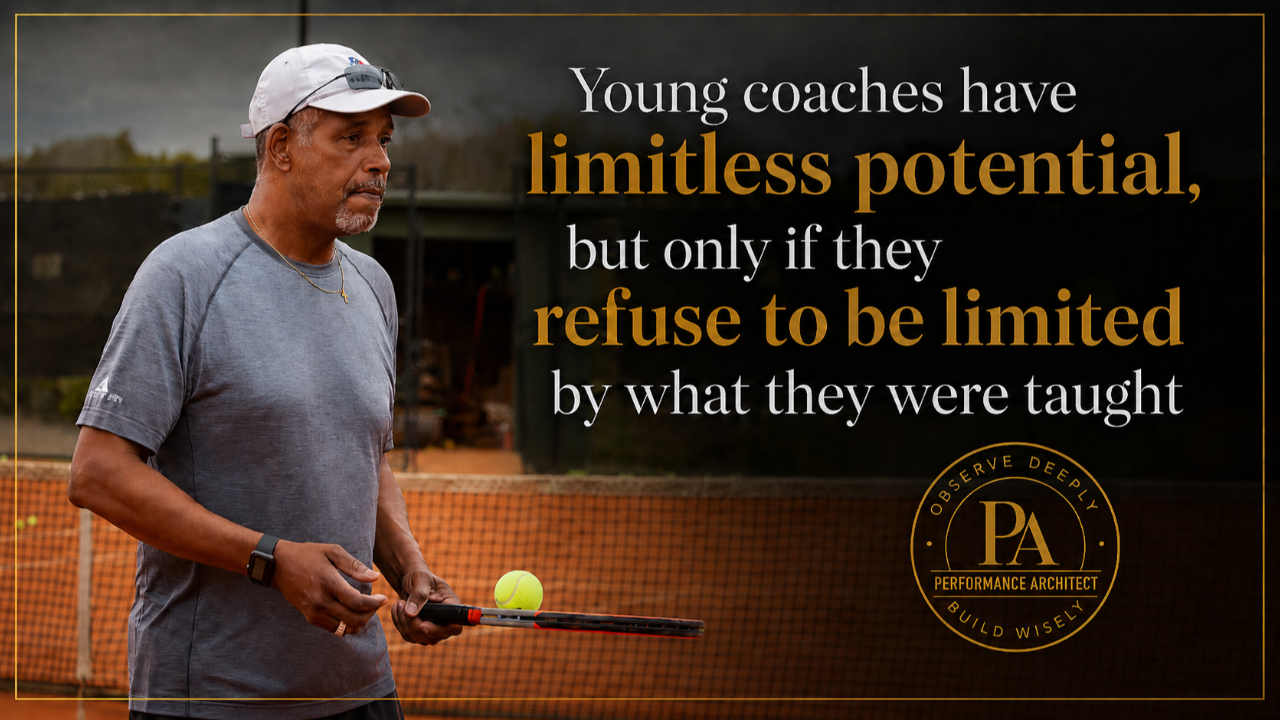
Young coaches have limitless potential, but only if they refuse to be limited by what they were taught.
I've sat with that sentence for a while now, and I want to be careful with it because it can sound like a shot at the coaches who came up before us. That's not how I mean it. Every coach starts somewhere. I started in Atlanta and then Charlotte, running an organization with an impressive name and not nearly enough experience to match it, borrowing almost everything I taught from the coaches who'd handed me a basket of balls and pointed me toward a court. I trusted their word because I hadn't yet earned the right to trust my own. I suspect that part is unavoidable. Before a coach finds a voice, they usually rent one.
The trouble starts when the rented voice becomes the only one they ever use.
A coach who was taught to run lines will run lines for years without asking what the lines are actually building. A coach who was taught to feed baskets and fix grips will keep feeding baskets and fixing grips long after the drill has stopped teaching anything the player couldn't have learned faster another way. A coach who grew up in a gym where the adults talked and the kids listened will construct that same room again and again because it feels normal, and normal has a way of disguising itself as correct.
That's not failure. That's inheritance. I've learned, slower than I'd like to admit, that inheritance and development are not the same transaction.
Coaching gets passed down mostly through exposure, not explanation. A young coach watches how a lesson gets run, how a mistake gets corrected, how a parent gets handled after a tough loss, and those patterns settle into the body before anyone ever puts language around them. Nobody sits you down and defends the choices. You just absorb the room. And what you absorb may have been useful once. It may have been built for a different player, a different decade, or a different problem entirely. It may have survived inside the culture simply because nobody with enough standing ever stopped to ask if it still worked.
If you're a young coach reading this, your job isn't to burn down everything you were handed. That would be arrogance wearing the costume of independence. Your job is to examine it. Why this drill, and what is it actually training underneath the visible stroke? What does this correction teach the parent to believe progress looks like? What happens to a player's decision-making if every answer in the lesson comes from the adult standing on the other side of the net?
Those questions matter because coaching is rarely just the thing you think you're teaching. You may believe you're teaching a forehand when what's actually landing is dependency, one clean rep at a time. You may believe you're building toughness when what you're really installing is a habit of hiding confusion until the match drags it out into the open where everyone can see it.
I don't think the best young coaches are simply the energetic ones. Energy helps, but it runs out. The best ones are curious. They don't stop at what works. They want to know why it works, for whom, and what else it's quietly producing while it's working.
That curiosity is what lets a coach grow past imitation without disowning the people who started them. It's the same thing my mother used to drill into me long before I ever coached tennis professionally: honoring where you came from and questioning it aren't opposites you have to choose between. They're both required, at the same time, from the same person. Gratitude and obedience are not the same word, no matter how often coaching culture treats them like synonyms.
I've been around this sport long enough now that I probably should have run out of surprises, and I haven't. Some of the sharpest ideas I hear still come from coaches who haven't been doing this long enough to believe the whole thing has already been figured out. That's a real advantage, but it disappears fast if they get too eager to sound certain.
Certainty sells. Players respond to it, parents pay for it, and facilities reward it because it looks like command from the outside. But certainty without examination hardens into a cage, and it hardens fastest around the coaches who are still building the eyes they'll need for the next thirty years.
A young coach doesn't need to know everything. They need to learn how to see more of it. The difference between a player who's confused and a player who's resistant. The moment a technical correction is actually a state problem wearing a technical costume. When a kid needs information, when they need structure, and when they just need room to go searching on their own.
That takes time, and it takes a coach willing to be more than a delivery system for somebody else's old instructions.
The future of this sport won't be built by young coaches who repeat what came before them with better music and cleaner social clips. It'll be built by the ones who can stand inside the tradition without letting the tradition own them.
Learn from everyone. Copy carefully when you have to. Respect the coaches who gave you your start. But don't ever let gratitude get mistaken for obedience.
Your potential was never limited by your age. I've come to believe it's limited by how quickly you stop asking better questions.
Never Miss a Moment
Join the mailing list to ensure you stay up to date on all things real.
I hate SPAM too. I'll never sell your information.
